24Hours Tel
0086-139 8951 3573
Free Inqiry
E-mail:[email protected]
24Hours Tel
0086-139 8951 3573
Free Inqiry
E-mail:[email protected]
A maintenance team replaces a failed half-inch brass nipple in a hotel water line. The replacement threads in cleanly, passes a short pressure test, and looks correct. Six months later, the joint weeps at the thread root, and the fitting shows a pinkish, porous surface. The problem is not the installer's wrench work. The replacement was a free-machining brass fitting with a different alloy, a different thread class, and no potable-water documentation. It fit the hole, but it did not fit the system.
That scenario is why brass pipe for plumbing should be treated as a specification item, not a hardware-bin commodity. The reliable approach is to define the pipe standard, alloy, thread form, pressure and temperature envelope, water chemistry, joining method, and acceptance documents before comparing price. Brass is durable and easy to machine, but those advantages disappear when a leaded fitting is installed in drinking water, when NPT and BSP threads are forced together, or when a thin-wall nipple is used where a standard-wall pipe is required.
The practical rule is simple: start with the pipe and the water, then select the fitting family. Do not start with the fitting that happens to be on the shelf.
Plumbing brass pipe is normally a seamless red brass product made to a recognized pipe specification. In North American practice, ASTM B43 is the common reference for seamless red brass pipe in standard sizes. The material is often UNS C23000, an 85/15 copper-zinc alloy known as red brass. It is selected for water, heat exchangers, fixture connections, and exposed lines where copper tube would be dented or where threaded joints are preferred. It is not the same product as a machined brass fitting, even when both are “brass.”
The first distinction is pipe versus tube. Pipe is normally specified by nominal pipe size, with the outside diameter fixed by the standard and the wall thickness changing by schedule or class. Copper tube is normally specified by outside diameter and wall type, such as Type L or Type M. A half-inch brass pipe and a half-inch copper tube may look similar at a glance, but their dimensions, thread engagement, and joining methods are different. Mixing the two because the nominal size matches is a common procurement error.
The second distinction is the thread standard. NPT is a tapered pipe thread used in North America. BSPP is a parallel thread, usually sealed with a washer or gasket. BSPT is a tapered thread used in many export markets. They are not interchangeable. A BSPP male thread may start in an NPT female port, but full engagement and sealing are not guaranteed. For imported plumbing assemblies, the purchase order should state the thread standard, the gauge requirement, and the sealing method, not just “half-inch thread.”
The third distinction is the application. A brass pipe used for potable water has different documentation requirements from a brass pipe used for a closed-loop heating system, compressed air, or an industrial process line. The alloy may be acceptable in one service and unacceptable in another. For plumbing work, the specification should say whether the pipe and fittings are intended for drinking water and which lead-free and material-safety requirements apply.
Brass covers a wide family of copper-zinc alloys. Red brass with roughly 85 percent copper and 15 percent zinc is common for pipe because it has good corrosion resistance and enough ductility for threading and bending. Cartridge brass, around 70/30 copper-zinc, is used for fittings, valves, and components that need higher strength. Free-machining brass often contains lead to improve chip formation and dimensional consistency. That last family is where plumbing projects get into trouble.
For potable-water plumbing, lead-free compliance is not a marketing phrase. It is a material and testing requirement. In the United States, NSF/ANSI 372 addresses the weighted average lead content of wetted surfaces, and NSF/ANSI 61 addresses the health effects of materials in drinking water systems. A supplier should be able to state the alloy, the lead content, and the applicable test report or certification. A generic “brass” description is not enough for a drinking-water line. The same caution applies in other markets with their own drinking-water rules, so the project specification should cite the local requirement rather than assuming one certificate covers every country.
There is a practical difference between “lead-free” and “no lead added.” Some lead-free brasses use silicon, bismuth, or other alloying elements to replace lead while maintaining machinability. These alloys can perform well, but they may have different machining behavior, thread quality, and pressure tightness than the old leaded grades. A purchasing team that switches alloys to satisfy a lead-free rule should also check the fitting dimensions, torque values, and sealing performance. The material change is not automatically a drop-in replacement at the factory level.
| Decision point | What to verify | Why it matters | Common procurement error |
|---|---|---|---|
| Pipe alloy | UNS number or alloy description, temper, and pipe specification such as ASTM B43 where applicable | Red brass and high-zinc brass do not behave the same in aggressive water or threaded joints | Accepting “brass pipe” without an alloy or mill certificate |
| Drinking-water status | Lead-free statement, NSF/ANSI 372 or local equivalent, and NSF/ANSI 61 or local equivalent where required | A fitting can be mechanically correct and still be unsuitable for potable water | Using a free-machining fitting because it threads well |
| Thread form | NPT, BSPP, or BSPT; gauge inspection; sealing method | Parallel and tapered threads seal by different mechanisms | Forcing a BSPP fitting into an NPT port with extra sealant |
| Pressure and temperature | Working pressure at the actual temperature, wall thickness, thread engagement, and water hammer allowance | Room-temperature ratings can overstate performance in hot-water service | Comparing only the nominal pipe size and not the service envelope |
| Documentation | Batch-level material report, dimensional report, thread gauge result, pressure test, and packaging mark | Traceability separates a repeatable plumbing component from a mixed-lot commodity | Accepting a brochure when the project needs batch records |
Brass pipe for plumbing is often chosen for its corrosion resistance and appearance, but pressure performance still comes from wall thickness, thread engagement, and support. A threaded joint reduces the effective wall at the thread root. If the pipe is thin-walled, over-tightened, or poorly supported, the failure point is predictable. The same nominal size can have different wall classes, and a fitting with a deep female thread may not leave enough engaged thread on a thin-wall nipple.
Temperature also changes the allowable working pressure. A brass pipe that performs well in a cold-water line may need a lower rating in a hot-water circulation loop, especially where chlorinated water, high velocity, or frequent thermal cycling is present. The purchase order should state the maximum continuous temperature and the maximum short-term excursion, not just the line size. If the system experiences water hammer, the specification should include a surge allowance. A pressure gauge that reads 80 psi during normal operation can see a much higher spike when a valve closes quickly.
For plumbing layouts, the less obvious issue is fit. Brass pipe is rigid. It does not bend around a joist like copper tube or flexible PEX. The design must allow for alignment, support spacing, thermal expansion, and access to threaded joints. A contractor who treats brass pipe like flexible tubing will create mechanical stress at the fittings, and that stress often appears as a leak at the thread or compression joint rather than as a visible pipe failure.
When comparing quotations, ask for the wall thickness or schedule, the thread engagement length, and the pressure-temperature basis. A supplier who can answer those questions is more likely to provide a repeatable product than one who only quotes by nominal size and “brass” material.
The joining method should be selected with the same care as the alloy. Threaded, compression, flare, push-to-connect, and push-on hose connections each place different demands on the brass component. A fitting that works well in one family may be a poor choice in another.
Threaded brass pipe and fittings are common in exposed plumbing, fixture connections, pumps, filters, and repair work. NPT and BSPT threads are tapered and seal by thread interference plus a sealant. BSPP threads are parallel and normally seal against a washer or an O-ring face. The installer should use the correct thread sealant for the application, apply it to the male thread, and leave the first one or two threads clean so the sealant does not enter the waterway. Over-tightening can distort the female fitting or crack the pipe, especially in small sizes.
A thread gauge is a simple quality tool that prevents expensive callbacks. If a batch of brass fittings is not gauge-checked, the first sign of trouble may be a joint that bottoms out before it seals or a fitting that threads on loosely and leaks despite heavy sealant. For imported plumbing products, the thread standard should be written on the purchase order and verified at incoming inspection.
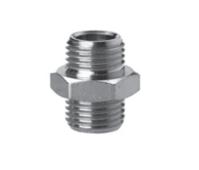
 Steel Pipe Fitting Hex Bushing 2531 with BSPT/BSP ThreadsFor projects where pipe thread standards are gauge-checked, this hex bushing offers BSPT/BSP dryseal threads in carbon or stainless steel.View Product →
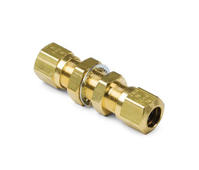
Compression fittings use a ferrule or olive to compress against the pipe or tube as the nut is tightened. They are convenient for small-diameter plumbing and instrument lines, but they are sensitive to tube condition, insert selection, and torque. A brass compression fitting on soft copper tube is not the same as a compression fitting on brass pipe. If the tube is out of round, scored, or not fully inserted, the ferrule cannot seal reliably. For plastic tubing, an insert may be required to prevent collapse.
The installer should follow the manufacturer's torque or turn count. “Tight plus a little more” is not a specification. A compression joint that is under-tightened may weep; one that is over-tightened may cut the tube or distort the ferrule. In potable-water service, the fitting materials and any lubricant on the O-ring or ferrule must also meet the local drinking-water requirements.
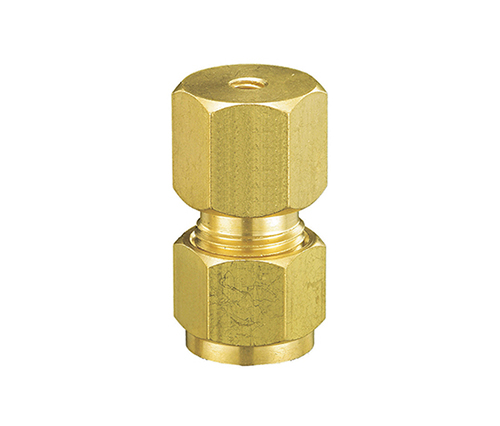 OEM 1/4 NPT Compression Double Male Connector for Fog SystemsFor compression tube connections where torque matters, this fog-system connector supports vacuum to 1000 psi and offers copper, stainless steel, or brass bodies.View Product →
Flare fittings are common in refrigeration, fuel, gas, and hydraulic work, and they appear in some plumbing and appliance connections. The two main flare angles are SAE 45 degrees and JIC 37 degrees. They are not interchangeable. A flare joint depends on a correctly formed cone, a matching seat, and a nut that pulls the cone into contact without cracking it. Brass is easier to flare than steel, but thin-wall tube can split if the flare is over-formed. For plumbing work, the specification should state the flare angle, tube material, and nut type.
Push-to-connect plumbing fittings have changed installation speed in repair and retrofit work. A proper joint depends on a clean, square-cut tube end, full insertion depth, a compatible O-ring, and a tube support or insert where required. The fitting is not a substitute for pipe support. If the tube is under side load, the O-ring may leak even though the connection “clicked.” Push-to-connect products are also sensitive to debris and freezing. They are useful in accessible locations, but concealed or buried joints should follow the manufacturer's approval and local code.
For projects that use this joining family, push-to-connect brass fittings should be selected with the same attention to pressure, temperature, and potable-water certification as threaded fittings. The convenience of the connection does not remove the material requirement.
Push-on hose fittings and hose barbs are common in flexible connections, pumps, filters, and temporary lines. They are not a substitute for rigid plumbing where the line is pressurized continuously or concealed. The hose material, clamp method, barb size, and working pressure must match. A brass hose barb can be well made and still fail if the hose is softened by hot water or if the clamp is placed behind the barb rather than over it.
Brass pipe can be soldered or brazed with the correct flux and filler, but the process is less forgiving than copper tube. Zinc in the brass can oxidize, and overheating can damage the alloy or leave a poor joint. Lead-free solder should be used for potable water. For many plumbing repairs, a threaded or mechanical connection is simpler and more serviceable, especially where the line can be isolated and drained.
A reliable brass plumbing installation follows a sequence. First, confirm the pipe, fitting, and thread standards against the drawing. Second, cut the pipe square and deburr the end. Third, clean the threads and check them with a gauge where the project requires it. Fourth, apply the correct sealant or tape to the male thread only. Fifth, assemble by hand, then tighten to the specified engagement. Sixth, support the pipe so the joint is not carrying bending load. Seventh, pressure-test at the specified pressure and duration, and inspect every joint before closing the wall or ceiling.
Inspection should include more than “no visible leak.” Check for thread engagement, sealant debris inside the line, correct washer placement, and adequate support. A joint that seeps only under hot-water expansion may pass a cold pressure test. If the system has a recirculation loop or a pressure-reducing valve, test at the expected operating condition, not only at static street pressure.
Common failures tend to repeat:
These are not exotic installation errors. They are procurement and workmanship errors that appear at the joint. A written installation checklist and a first-article inspection can catch them before the system is closed.
Brass pipe for plumbing is often sold on the promise of corrosion resistance, but corrosion resistance is water-specific. High-zinc brasses can suffer dezincification in certain waters, leaving a porous copper-rich structure that looks pink and loses strength. Red brass with higher copper content is generally more resistant, but it is not immune to every water condition. Chlorine and chloramine disinfectants, low pH, high carbon dioxide, soft water, elevated temperature, and low flow can all influence the risk.
A plumbing specification should therefore include the water chemistry or at least the known aggressive conditions. If the water is aggressive, the design may need a different alloy, a liner, a filter, or a maintenance plan. The same principle applies to galvanic corrosion. Brass connected to steel or aluminum in the presence of an electrolyte can create a battery that eats the less noble material. Dielectric unions, insulating bushings, or a change of material can break the electrical path, but the detail must be designed rather than improvised on site.
Longevity also depends on velocity and stagnation. Excessive flow can erode the inner surface, especially at fittings with sharp transitions. Long periods of stagnation can allow biofilm and scale to form. A brass pipe that is correctly selected for pressure but incorrectly selected for water chemistry may still fail early. The purchasing decision should include the operating environment, not only the catalog page.
Brass plumbing components are often purchased in mixed lots: pipe from one mill, fittings from another, and valves from a third. That mix is workable only when the specifications align. A purchase order for brass pipe for plumbing should identify the pipe standard, alloy, nominal size, wall class, thread standard, end finish, marking, and documentation. For fittings, it should identify the fitting standard, material, thread form, sealing method, pressure rating, and potable-water status.
At incoming inspection, check the basics before the product reaches a job site. Confirm the marking on the pipe or fitting, measure the thread with a gauge, verify the dimensions, and review the material certificate. For drinking-water products, check that the lead-free and material-safety documents match the actual alloy and supplier. A certificate for a different alloy or a different factory lot is not traceability.
A manufacturer's pipe fittings catalog (PDF) can help the design team compare sizes and configurations, but the catalog should support the purchase order, not replace it. The order should still state the project-specific requirements that the catalog cannot guarantee, such as water chemistry, local code, and acceptance testing.
Useful supplier questions include:
Thread protection deserves separate attention. Brass threads are easily nicked in bulk packaging. A nicked thread can cut sealant, damage a female fitting, or create a leak path. Caps, sleeves, and compartmented cartons are not cosmetic. They are part of the quality system for a plumbing component.
Brass is not a low-cost material by weight, and lead-free alloys can be more expensive to machine than leaded grades. The lowest unit price may still produce the highest installed cost if the thread requires rework, if the fitting fails inspection, or if the alloy is rejected by the water authority. A project manager should compare total installed cost: purchase price, incoming inspection, installation time, leak risk, callbacks, and replacement access.
Lead time also matters. A custom brass fitting with a special thread or a potable-water certificate may take longer than a catalog item. If the project schedule assumes same-day availability from a local distributor, the specification should be frozen early enough to avoid substituting an unapproved alloy. For repair work, keeping a small, documented stock of the correct pipe nipples, couplings, and washers is often more economical than improvising with whatever is on the truck.
The lifecycle view is straightforward. A correctly specified brass pipe and fitting assembly can last for decades in a compatible water system. A mismatched assembly can fail in months. The difference is not the color of the metal. It is the alloy, thread, seal, support, water chemistry, and documentation working together.
Before releasing a purchase order or starting an installation, confirm the following items:
Brass pipe for plumbing works best when it is treated as an engineered assembly. The pipe, fitting, thread, seal, and water are a system. When one of those elements is chosen only by nominal size or lowest price, the joint becomes the weakest point. When they are specified together, brass delivers the durability and serviceability that made it a plumbing material in the first place.
Add:Xingzhong Road DianKou Town Zhuji City Zhejiang Province China
Mob: 0086-139 8951 3573
Tel: 0086-575-87560582
Fax: 0086-575-87560582
E-mail:[email protected]

 英语
 西班牙语