24Hours Tel
0086-139 8951 3573
Free Inqiry
E-mail:[email protected]
24Hours Tel
0086-139 8951 3573
Free Inqiry
E-mail:[email protected]
In the construction of industrial fluid and gas transmission systems, the choice of metal components directly impacts long-term structural integrity and operational efficiency. For senior engineers and wholesale procurement specialists managing high-capacity systems, deciding between copper-based and iron-based alloys requires a multi-dimensional evaluation of metallurgical characteristics, mechanical performance, and total life-cycle economic models. This report provides a detailed technical comparison, highlighting the unique advantages of brass components in the global industrial landscape.
The core performance gap between brass and stainless steel is rooted in their atomic structures and alloying elements. Brass is primarily a substitutional alloy of copper and zinc. By modulating the zinc content (typically between 30% and 40%), manufacturers produce
Conversely, stainless steel is an iron-based alloy relying on a minimum chromium content of 10.5% to form a passive chromium oxide layer. While this layer provides excellent protection in specific chemical environments, the high nickel and molybdenum content in grades like 316 significantly increases the work-hardening rate. This mechanical hardness, while beneficial for structural load-bearing, presents challenges in threaded connections and sealing applications where material conformity is required to prevent microscopic leaks under high pressure.
In high-pressure pneumatic and hydraulic environments, the mechanical interface between male and female threads determines the system's failure rate. Brass threaded joints exhibit superior performance due to their moderate modulus of elasticity and natural surface lubricity. When torque is applied to a brass connector, the metal undergoes controlled microscopic deformation, allowing the threads to conform to one another and create a gas-tight seal even without excessive chemical thread sealants.
Stainless steel faces the technical challenge of a high risk of galling. When the protective oxide layer is stripped away during tightening, direct metal-to-metal contact occurs. Under high pressure, these surfaces can undergo localized cold-welding. Once a stainless steel fitting galls, it essentially fuses with the mating component, making non-destructive disassembly impossible. This leads to increased downtime and component scrappage during maintenance cycles. In contrast, brass fittings maintain their thread integrity across multiple assembly and disassembly cycles, ensuring lower long-term maintenance costs.
The understanding of corrosion resistance in industrial procurement is often oversimplified. While stainless steel excels in acidic environments, brass connectors provide indispensable localized protection for water and gas distribution. The development of Dezincification Resistant (DZR) brass alloys represents a significant advancement in materials science. By adding arsenic or tin to the alloy, manufacturers prevent the selective leaching of zinc in stagnant or high-mineral-content water environments.
Furthermore, the copper content in brass fittings exerts a unique bio-inhibitory effect. Extensive laboratory testing confirms that copper-based surfaces naturally inhibit the proliferation of pathogens, including Legionella and E. coli. Stainless steel lacks this property and is prone to supporting the formation of complex biofilms. For industrial cooling towers and commercial water systems, using brass fittings serves as a passive defense mechanism against biological contamination, reducing reliance on aggressive chemical biocides.
In systems where temperature regulation is critical, such as HVAC and industrial heat exchangers, the thermodynamic properties of the fitting material are decisive. Brass possesses a thermal conductivity of approximately 110 to 120, which is nearly five times higher than that of common stainless steels. This high conductivity allows brass connectors to dissipate heat rapidly, preventing localized overheating that could lead to seal failure.
The Coefficient of Thermal Expansion (CTE) is another vital factor in applications with fluctuating temperatures. The CTE of brass aligns closely with copper tubing and other common industrial materials. This compatibility ensures that as the system heats and cools, the brass threaded fittings expand and contract at a rate similar to the surrounding pipework. This synchronization minimizes mechanical stress at joints and prevents the "back-off" effect where fittings loosen over time due to mismatched thermal movement.
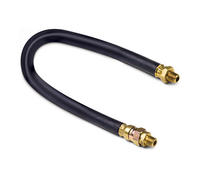
The non-sparking nature of brass makes it a mandatory standard in several specialized industrial sectors. In environments conveying flammable gases or with high concentrations of Volatile Organic Compounds (VOCs), using steel tools on stainless steel fittings carries the risk of creating sparks that could ignite an explosion. Brass hose connectors, being non-ferrous, do not produce sparks upon impact, providing a critical safety layer for oil refineries, grain silos, and chemical processing plants.
In pneumatic systems, the internal smoothness of the fitting is a primary factor in flow efficiency. Precision machining capabilities for brass fittings allow for a lower surface roughness (Ra) in the internal bore. Reducing surface roughness minimizes boundary layer turbulence of the air or fluid passing through the connector, thereby lowering the friction coefficient and pressure drop across the joint. This allows the entire system to operate at lower energy consumption while maintaining the required output pressure for tools or actuators.
A rigorous economic analysis of fitting selection must move beyond the initial purchase price to consider the Total Cost of Ownership (TCO). While raw copper prices fluctuate, the manufacturing efficiency of brass fittings consistently makes them more competitive at wholesale prices compared to stainless steel. The energy required to melt and forge brass is significantly lower than that of stainless steel, contributing to a lower carbon footprint and production cost.
The durability and ease of maintenance provided by brass connectors further enhance their economic profile. Because galling is absent and seals are easily achieved, the labor time required to install brass threaded fittings is greatly reduced, translating into substantial savings for large-scale infrastructure projects. Additionally, the high scrap value of brass ensures that at the end of the system's life, the recovered material retains a high percentage of its original value, creating an attractive circular economy model.
For large-scale distributors and industrial contractors, supply chain reliability is as critical as product quality. Partnering with specialized brass fitting manufacturers provides access to massive production capacities and customized engineering support. From general-purpose brass hose connectors to high-precision brass tube fittings for aerospace, a one-stop procurement range simplifies the purchasing process and optimizes inventory management.
Global market logistics require a deep understanding of international engineering codes and shipping standards. By maintaining large inventories of NPT, BSPP, and BSPT thread standard components, manufacturers ensure rapid delivery of wholesale orders. This responsiveness is vital for minimizing project delays and ensuring the smooth execution of critical maintenance work.
ASM International, Metals Handbook, Volume 2: Properties and Selection: Nonferrous Alloys and Special-Purpose Materials, Tenth Edition.
Copper Development Association (CDA), Technical Report: Corrosion Resistance of Copper and Copper Alloys in Industrial Water Systems.
American National Standards Institute (ANSI), Standard B16.15: Cast Bronze Threaded Fittings, Classes 125 and 250.
International Organization for Standardization (ISO), ISO 228-1: Pipe threads where pressure-tight joints are not made on the threads.
National Association of Corrosion Engineers (NACE), Corrosion Data Survey: Metals Section, Sixth Edition.
Society of Automotive Engineers (SAE), SAE J512: Automotive Tube Fittings - Physical Properties and Performance Requirements.
The Minerals, Metals & Materials Society (TMS), Journal of Materials Engineering and Performance: Analysis of Galling in Ferrous vs. Non-Ferrous Threaded Joints.
United States Environmental Protection Agency (EPA), Lead and Copper Rule Framework and Technical Material Compliance Guide.
Add:Xingzhong Road DianKou Town Zhuji City Zhejiang Province China
Mob: 0086-139 8951 3573
Tel: 0086-575-87560582
Fax: 0086-575-87560582
E-mail:[email protected]

 英语
英语 西班牙语
西班牙语