24Hours Tel
0086-139 8951 3573
Free Inqiry
E-mail:[email protected]
24Hours Tel
0086-139 8951 3573
Free Inqiry
E-mail:[email protected]
You have a 3/8 in. copper tube that needs to connect to a valve body with a 1/2 in. NPT port. The application is a commercial vehicle air brake system, and the line operates at a pressure that must remain tight for years. The first decision is not which supplier is cheapest, but whether the brass fitting you choose is the right mechanism for that copper tube.
The conclusion is straightforward: brass fittings for copper tubing are a proven, widely accepted choice. They are compatible with copper, easy to install with basic hand tools, and available in standards that cover everything from household plumbing to heavy-duty truck air brake systems. But you cannot treat them as a single family. Compression fittings, SAE 45-degree flare fittings, and DOT copper tube fittings work differently, follow different standards, and are suited to different pressure and vibration conditions. Matching the mechanism to the copper tube diameter, wall thickness, and thread standard is what makes a connection last.
This article covers what tends to matter in real engineering and purchasing decisions: why brass works with copper, which fitting types exist, which standards and dimensions to check, how to install them without damaging the tube, and what to verify before placing a purchase order.
The main reason brass fittings are used with copper tubing is that both metals are copper alloys. The galvanic potential difference between brass and copper is very small, so there is little to no risk of galvanic corrosion at the joint. In practice, this means a brass fitting mated to a copper tube will not create a corrosion cell that eats away the tube, a risk that can arise when certain stainless steel fittings contact copper in wet environments. For water, compressed air, refrigeration, and hydraulic circuits, this compatibility is very valuable.
Brass also has the right mechanical hardness for a compression connection. When you tighten a brass nut, the brass ferrule is squeezed against the copper tube. The tube deforms slightly and forms a sealing band. If the ferrule material were too hard, it would cut into the copper. If it were too soft, it would never produce the radial force needed to seal. Brass sits inside that useful window, which is why it dominates this product category.
Another practical advantage is machinability. Brass is a very good material for CNC turning and forging, so manufacturers can produce elbows, tees, unions, bulkhead fittings, female adapters, and custom shapes with tight tolerances. The fitting bodies are made directly from forged or extruded brass stock, and the threaded ends can be cut to the required standard. This makes a wide variety of geometries available from stock without expensive casting molds or complex welding operations.
Compared with soldering or brazing, brass fittings are removable. That matters a lot during maintenance, because a system upgrade, a wrong routing decision, or a blocked valve usually requires a fitting to be disconnected. If the original connection was soldered, you have to cut the tube and re-solder, which needs a torch and may expose nearby wiring or hoses to heat damage. With a brass fitting, a technician simply releases the nut and slides the components apart.
Compared with press fittings, brass fittings need no special crimping tool. A technician can install or replace a brass fitting with two open-end wrenches. For maintenance crews working in tight spaces on a truck, inside a machine frame, or in a residential plumbing cabinet, that is a dramatic practical difference. It also gives you the chance to verify the joint visually as you tighten it.
However, not every brass fitting is suitable for every copper tube. The ferrule dimensions, the tolerance of the internal bore, the thread accuracy, and the material composition all affect whether the connection will seal. A brass fitting designed for thick-wall copper tube will not fit properly on thin-wall tube, because the ferrule travel is not the same. This is why the rest of the article is focused on precise, measurable parameters rather than a generic claim that brass is “good.”
A compression fitting consists of three parts: the fitting body, the compression nut, and the ferrule. When you install it, the copper tube is inserted into the body of the fitting until it reaches an internal stop. The ferrule is placed over the tube, and the nut is threaded onto the body. As you tighten the nut, it pushes the ferrule axially into the tapered gap between the nut and the body, squeezing the ferrule against the copper tube. This creates a sealing ring that prevents fluid from escaping.
Compression fittings are most useful in low to medium pressure systems: water pipes, heating circuits, pneumatic actuators, laboratory gas lines, refrigeration service connections, and many industrial coolant systems. They are often chosen when the line is fixed and the device you connect to might need to be replaced or separated later. In refrigeration, for example, a compression fitting on the copper line to an expansion valve gives the technician a fast way to open and close the system without releasing refrigerant from the entire line.
The main advantage is simplicity. Cutting the tube and deburring it is all you need to do before assembly. The main disadvantage is that compression fittings can be sensitive to vibration. Over time, the nut can loosen if the copper line is not supported by a clamp or bracket. In high-vibration environments, you need to secure the tube at a short distance from the fitting to prevent the ferrule from losing its grip.
For a purchasing manager, the critical parameter is copper tube wall thickness. The ferrule only works correctly if the copper tube outer diameter and wall thickness are inside the fitting’s designed range. A very thin wall tube will not support the ferrule squeeze and may collapse inward. A very thick wall tube may leave the ferrule riding on the surface rather than embedding slightly into it. Always check the fitting specification against the copper tube grade, such as Type K, Type L, or Type M, before approving a part number.
Compression fittings come in many material and size variants. The standard application is a brass body with a brass ferrule, which works fine in most non-aggressive fluids. For seawater or very humid environments, the same fitting can be supplied with a nickel-plated body to resist surface corrosion. The choice of material does not change the mechanism, but it changes the service life in a given environment.
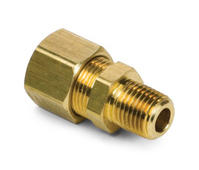
 1/4 NPT Compression Double Male Connector1/4 NPT Compression Double Male ConnectorView Product →
The SAE 45-degree flare fitting works differently. The copper tube end is flared outward into a 45-degree bell shape using a flaring tool. The flare is then pressed against a matching 45-degree conical seat in the fitting body by a long nut. The seal is formed by metal-to-metal contact between the flared copper and the brass cone, so no rubber O-ring is involved. This makes the joint suitable for higher temperatures and for fluids that might attack elastomeric seals.
Typical applications for SAE 45-degree flare fittings include automotive fuel lines, hydraulic oil lines, industrial cooling water circuits, and some air compressor discharges. The standard SAE J512 defines the dimensions and performance of these fittings for automotive and industrial use. In many cases, a 45-degree flare fitting is chosen for its ability to stay tight under moderate vibration, because the axial force from the long nut keeps the flared cone in contact even if the clamp points are not perfectly rigid.
Installation quality depends entirely on the condition of the flare. The copper tube must be cut square, deburred, and flared with a properly adjusted tool. Hard copper should be annealed before flaring, because hard material tends to crack on the outer edge of the flare. Any crack or uneven surface in the flare becomes a leak path under pressure. After the flare is formed, inspect it with a magnifying glass or touch the surface with a finger. A smooth, uniform flare without ridges or sharp marks is what you need before assembling the joint.
The SAE 45-degree flare fitting is available in different shapes and thread options. A female connector, 90-degree elbow, tee, or union can all be threaded with NPT, SAE straight thread, or BSPP. The body is typically forged brass, and the nut is made of brass or slightly harder material to prevent stripping during repeated tightening. Some high-pressure variants use a brass nut with a long rod for better torque transmission.
When choosing between a compression fitting and a flare fitting for the same copper tube, the practical decision usually comes down to pressure, vibration, and frequency of disassembly. If the line is static, low pressure, and the fitting may be opened only once a year, a compression fitting is quicker to install. If the line carries a hot oil or a pressurized gas, and you expect mechanical vibration, a flare fitting is often the safer engineering choice.
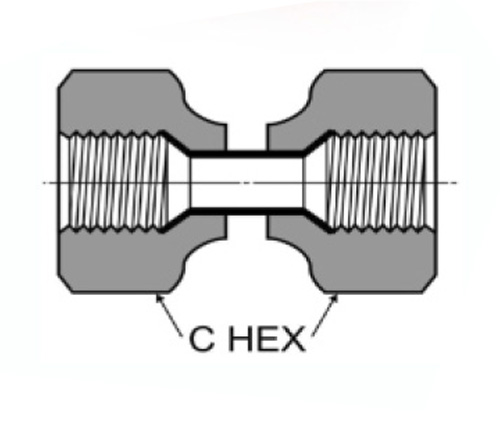 U440# SAE 45° Flare Brass fittings Swivel Nut ConnectorProduct Features: ■■ All brass construction ■■ Resists vibration with use of long nut ■■ UL listing ■■ Functional requirements of SAE J512 and J513View Product →
DOT copper tube fittings are a distinct category designed for commercial vehicle air brake systems. They are governed by the US Department of Transportation FMVSS 106 standard, which specifies the dimensional, material, and performance requirements for pneumatic brake fittings. The fittings typically use a compression mechanism, but the ferrule and nut are engineered for copper tube sizes used in truck air brake lines, such as 5/16 in. (8 mm), 3/8 in. (10 mm), and 1/2 in. (12 mm).
What makes a DOT fitting different from a generic compression fitting is the certification and the design for extreme conditions. A DOT copper tube fitting must be marked with “DOT” on the body or the nut so that inspectors can verify it at a glance. The nut and body are made from material that stays ductile at low temperatures, because a truck may park overnight in northern regions at -30 C or below. The ferrule and compression mechanism are designed to hold tight through the cyclic pressures of brake applications, which puts repeated stress on the joint.
In a real air brake system, these fittings connect copper lines to brake chambers, control valves, spring brakes, and other components. Because brakes are a safety system, every joint must be reliable from the first installation until the truck reaches the end of its service life. Using an unmarked or generic compression fitting on a brake line is a serious quality risk and, in many jurisdictions, a compliance violation.
The selection process for DOT fittings should include a verification step for the copper tube size and wall thickness. A DOT fitting designed for a 3/8 in. copper tube with a 0.030 in. wall will not perform correctly on a 1/4 in. hard-drawn copper line. The ferrule geometry and the body bore are specific to the tube outside diameter. For this reason, it is better to order a complete set of fittings from a supplier that provides a clear specification sheet for each tube size.
When you are checking a candidate supplier, confirm that the DOT product line carries the DOT marking on every piece, and that the supplier can provide material test reports for individual batches. Volume buyers in the commercial vehicle aftermarket should also ask about traceability. If a brake fitting fails in the field, you need to know which batch it came from and what raw material was used.
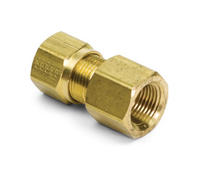
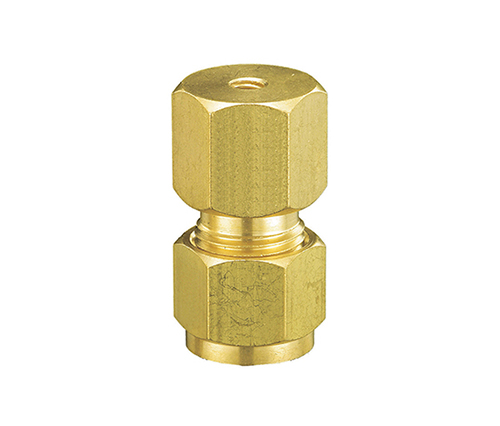
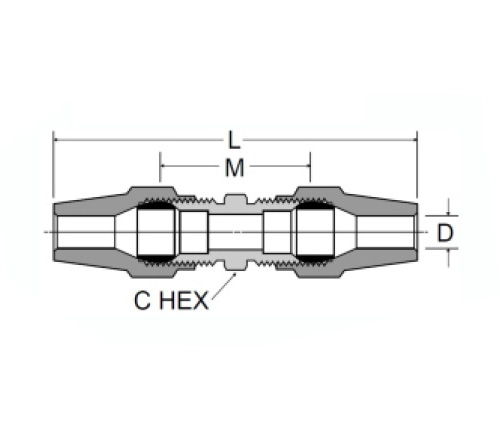 1362 Air Brake Copper connector UnionProduct Features: ■■ Brass Body ■■ Meets D.O.T. FMVSS571.106 Performance ■■ Meets functional Requirements SAE J246 ■■ Reusable ■■ Optional Pre-applied Thread Sealant ■...View Product →
The mechanism is only one half of the selection. The other half is geometry. A copper tube system is rarely a single straight line; it usually requires a change of direction, a branch, or a transition to another tube size or thread. That is where unions, elbows, tees, bulkhead fittings, and adapters come into play.
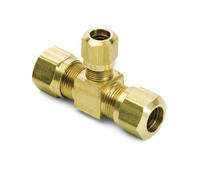
A straight union joins two tubes of the same diameter. If the two tubes have different diameters, a reducer union is used. A 90-degree elbow turns the line at a right angle, which is common in compact machine frames. A tee splits the flow into a branch, and a cross splits it into four. A female adapter converts a threaded port to a tube connection, while a male adapter converts a tube connection to a threaded fitting. Bulkhead unions pass through a panel, allowing fluid to cross a cabinet or chassis wall without leakage.
Because these shapes are made in the same brass material and with the same sealing mechanism, the quality factors remain the same: thread accuracy, bore finish, and ferrule material. The difference is whether the fitting body is forged or machined. Forged bodies generally have better strength and a stronger internal grain structure, while machined bodies are easier to produce in low volumes with custom dimensions. For standard sizes, a forged body is usually the better value because it resists deformation when the nut is tightened.
In maintenance inventories, the most useful shapes are usually male elbow, female adapter, union, tee, and 90-degree elbow. Keeping these in a few common tube sizes covers the large majority of repairs. It is more efficient to identify the shape and thread size before ordering rather than relying on a cabinet full of loose fittings that may not match the actual joints.
Brass fittings are not selected by a rough guess; they are selected by a standard. For North American industrial and automotive systems, NPT threads and SAE J512 flare or compression dimensions are common. For European and many mobile hydraulic systems, BSPP and BSPT threads are the norm. DOT FMVSS 106 covers air brake fittings for commercial vehicles. Each standard defines thread pitch, end geometry, dimensions, and pressure test procedures.
In many procurement decisions, the easiest mistake to make is mixing up NPT and BSPP threads. They may look similar on a part list, but they have different thread angles and pitches, so they are not interchangeable. A fitting with an NPT male thread will not seal properly in a BSPP port, and forcing it can damage the thread. This is why a clear thread standard should appear on every purchase order, and why a good supplier will state the thread standard explicitly in the product description and in the PDF catalogue.
| Standard | Thread or End Type | Typical Use | Notes |
|---|---|---|---|
| SAE J512 | 45-degree flare or compression | Automotive hydraulic, refrigeration, fuel lines | Common in North American passenger and commercial vehicle plumbing |
| SAE J514 | 37-degree flare (JIC) | High-pressure hydraulic fluid systems | Mostly used with steel or stainless steel tube, but brass versions exist for lower pressures |
| DOT FMVSS 106 | Compression push-on or tube fitting for air brake | Commercial vehicle air brake systems | Requires DOT marking on the fitting |
| BSPP / BSPT | Parallel or tapered pipe threads | European industrial and pneumatic systems | Not interchangeable with NPT |
| NPT | Tapered pipe thread | General plumbing and industrial air/water systems | Seal is made on the thread flanks, usually assisted by sealant tape |
Material standards are equally important. Leaded brass alloys such as C36000 and C37000 are used for many fittings because they machine well and reach the right hardness. In the European Union, CW617N is a common alloy for brass pipe fittings. For drinking water applications, lead-free or low-lead alloys such as C69300, CW511L, or silicon brass are preferred. If you do not know the alloy, you cannot predict how the fitting will behave in a hot water system or a food processing line.
Dimensional standards also cover the copper tube side. The outside diameter of a 3/8 in. copper tube is about 9.52 mm, and the wall thickness differs depending on the tube grade. Type M is a thin-wall tube, Type L is medium, and Type K is thick wall. The fitting bore is usually designed for a specific outside diameter, but the end clearance and ferrule travel must also match the wall thickness. If you specify just the outer diameter without the wall thickness, you may receive a fitting that looks correct on the shelf but does not seal when installed.
Pressure and temperature ratings are often presented by suppliers as a maximum working pressure at room temperature. That kind of data is useful, but it can be misleading for real applications. The actual service pressure must be evaluated at the expected service temperature. Brass loses strength as temperature rises, and plastic or elastomeric seals may become stiff or soft. In low-temperature air brake systems, the brass fitting must remain ductile enough that the nut does not crack when it is tightened. Ask the supplier for the operating temperature range and the pressure rating at the upper and lower limits.
Certification and traceability are part of the standard package. DOT fittings must carry a DOT mark. ISO 9001 certification of the factory is a baseline indicator of process control, but product-level testing gives more direct evidence. For export to North America, a metal parts supplier should be able to provide SGS or equivalent material test reports for the batches they ship. The report should match the part number, material grade, and batch information. This is not paperwork; it is a way to prove that the copper tube fitting you received was made from the correct alloy in a controlled process.
When you are reviewing a supplier for DOT air brake fittings, look for a dedicated air brake product line with clear references to DOT approval. You can start by reviewing the existing air brake fittings range and verifying the DOT marking policy before placing a larger order.
The first step is always cutting. A tube cutter, not a hacksaw, should be used for copper tubing. A tube cutter produces a square, clean end with a small burr instead of loose metal chips. A hacksaw can leave debris inside the tube, which may later enter a valve or a brake chamber. After cutting, deburr both the inner and outer edges of the tube end using a deburring tool or a fine file. A burr on the inner edge can interfere with the flow of fluid, and a burr on the outer edge can prevent the ferrule from seating squarely on the tube surface.
The cut must be square to the tube axis. If the end is slanted, the ferrule will compress unevenly. On one side it may bite deeply into the tube, while on the other side there is a gap. That gap is a potential leak path. For tube sizes up to about 12 mm, the best practice is to use a tube cutter with the tube clamped in a vise, rotating the cutter in small increments until the cut is complete. Then one quick pass with a deburring tool cleans the edge.
Before installing the fitting, wipe the tube end with a clean cloth. Grease or dirt on the surface reduce the friction between the ferrule and the tube. This can cause the ferrule to spin instead of biting, especially during assembly. It is also a good idea to check the tube surface for scratches. Deep scratches in the copper that run along the length of the tube may cross the sealing area and create a leak under pressure.
Push the copper tube into the fitting body until it hits the internal stop. Some compression fittings do not have a visible stop, but most brass fittings designed for copper tubing do. Then slide the ferrule over the tube and back into the body, and start the nut onto the threads by hand. The nut should turn freely until it makes contact with the ferrule. If you feel resistance early, stop and check that the tube has not stuck to the ferrule or that the ferrule is not twisted.
Once the nut is hand-tight, use a wrench to turn it one quarter to one half turn beyond that point. Many suppliers publish a recommended torque value for each nut size in their catalogue. A typical value for a 3/8 in. compression fitting may be in the range of 25 to 35 Nm, but this can vary depending on the ferrule design and nut geometry. If the nut is overtightened, the ferrule can deform too much and cut into the copper tube. If it is undertightened, the ferrule may not create enough radial force and will leak during pressure testing.
Hold the fitting body with a second wrench while you turn the nut. If the body rotates, it can twist the copper tube and damage the pipe behind it. Also, do not try to assemble a compression fitting while the tube is under tension. The tube should be free to move slightly so that the ferrule seats evenly.
If you need to reuse a compression fitting after disassembly, inspect the ferrule carefully. A ferrule that has already been squeezed has a noticeable ridge on the inner surface, and the copper tube will show a matching indentation. Reusing the same ferrule on a new section of tube may not create a second reliable seal. It is better to replace the ferrule with a new one, or to re-cut the tube end and use fresh material.
The flare fitting procedure is different. Measure the tube length, cut it, and deburr it thoroughly. Then place the long nut onto the tube before flaring. If you forget the nut, you will have to cut the tube again. The flaring tool should be clamped around the tube at the correct height, then the cone is driven down to form the bell shape. The operation must be performed slowly, especially on hard copper. For hard copper, the tube should be annealed first by heating it with a torch and allowing it to cool, otherwise the flare may crack at the rim.
After flaring, inspect the flare for even thickness and a smooth surface. The flare should not have radial cracks, steps, or excessive thinning at the edge. A good flare seats symmetrically on the brass cone of the fitting. When you assemble the joint, align the flared tube with the cone and start the nut by hand. Then tighten the nut with a wrench while holding the fitting body steady. As the nut tightens, the flare is compressed against the cone. Do not force the nut beyond the point where the body stops moving. An overtightened flare can split the copper or damage the fitting seat.
In some high-vibration installations, a backup wrench can be used on the fitting body while the nut is torqued. This is the standard method in hydraulic work, and it prevents the flare from being twisted by the nut. A twisted flare creates a leak at the cone.
The first and most common mistake is applying excessive torque to a compression fitting. Many technicians believe that the tighter the nut, the better the seal. In a compression fitting, the ferrule needs a certain deformation, but after that point it will work against you. It can cut through the copper, make the joint impossible to disassemble, and cause premature tube failure.
The second common mistake is using a compression fitting in a highly vibrating run without a support clamp. The vibration loosens the nut gradually. For safety-critical air brake systems, every tube should be supported at reasonable intervals so the fitting is not asked to absorb all the movement. If the tube cannot be clamped, consider using a flared fitting or a push-on fitting with a stronger locking mechanism.
Thread sealant tape is another source of trouble. For NPT pipe threads, one to two turns of PTFE tape around the male thread is normally enough. If you wrap the tape too thickly, the excess tape can squeeze out of the thread and enter the bore, interfering with the ferrule seal. For straight thread or SAE flare connections, no sealant tape should be used at all; these connections rely on a different sealing surface.
A fourth mistake is installing a brass fitting on a copper tube that has a damaged surface. If the tube has been scratched or kinked, the ferrule may not seal over the damaged area. In a long tube run, it is often better to cut the damaged section and use a union to connect two good ends, rather than trying to make a fitting work on a poor tube surface.
After assembly, the joint should be pressure tested. Use clean, dry compressed air or nitrogen and apply a soap solution to the fitting area. Bubbles indicate leakage. If you see a small leak, you can try turning the nut an additional one eighth to one quarter turn. If that does not stop the leak, stop tightening and inspect the assembly. A leak after two or three tightening attempts usually means the tube end is not clean, the ferrule is damaged, the flare is cracked, or the wrong fitting size is being used.
For air brake systems, the pressure should be raised to the system working pressure and held for a short period while you monitor the joint. Never use a torch to find a leak. Never pressurize a system before all nuts are hand-tightened. For maintenance, check the torque on the fitting after the first week of operation. This is especially important for new systems, because tubing often settles into its mounting position during the first few cycles. A single re-torque pass after installation avoids most long-term seepage problems.
Before you send an enquiry, record the four items that matter most: the copper tube outside diameter, the copper tube wall thickness, the thread type on the mating component, and the expected working pressure and temperature. Use a caliper to measure the outside diameter, not a tape measure. A 3/8 in. copper tube will typically measure between 9.50 and 9.54 mm. The wall thickness can be measured through the cut end, or you can check the stamping on the original tube.
For the thread type, verify whether the port is NPT, BSPP, BSPT, SAE straight thread, or a metric thread. If you cannot see the port, use a thread gauge or take a fitting known to suit the port and compare it. The correct fitting will thread on smoothly by hand for a few turns, then require a wrench. A wrong thread will feel tight after one or two turns and usually will not produce a seal.
It is also useful to check the length of the copper tube section. If you are using a tube union, the insertion depth may matter. Too short a tube may not reach the internal stop, leaving the ferrule partially unsupported. Too long a tube may interfere with the valve or block a passage. Always measure twice before cutting.
The application determines the fitting type. For the heavy-duty truck market, DOT copper tube fittings are mandatory for any air brake line. They must be marked DOT and should be selected with the correct copper tube wall thickness. For industrial air systems, water lines, or heating circuits, a compression fitting is often the simplest and most economical solution. For oil lines and hydraulic systems where the pressure is higher, a 45-degree flare fitting is commonly chosen instead.
Fluid type also changes the material choice. In hot water systems, brass alloys without a strong dezincification resistance may slowly lose zinc, leaving a porous surface. If the water is high in chlorides, such as in some coastal municipal supplies, you should look for a low-lead brass with dezincification inhibition. In oil circuits, yellow brass is usually fine because the oil does not react with the alloy. In compressed air, the moisture content matters. Even in a moderate humidity environment, a nickel-plated brass fitting may last longer than a bare brass one in the same spot.
Temperature ranges should be specified along with pressure. For DOT air brake systems, the whole fitting assembly must be able to function at very low temperatures. The brass body and ferrule are designed for that, but the elastomer sealing parts, if any, must also remain flexible. For refrigerants, check the material compatibility table of the specific fitting, especially if the refrigeration circuit uses synthetic oils or high-pressure carbon dioxide.
Brass fittings are produced in huge volumes by many factories, and the lowest price often comes with compromises. One risk is alloy substitution. A factory may use recycled brass rather than a certified alloy such as CW614N, C36000, or DOT approved material. The fitting may have a similar surface appearance but can differ in hardness and corrosion resistance. After installation, the thread may gall, or the ferrule may not deform as designed.
The second risk is dimensional tolerance. Compression fittings rely on close tolerances between the ferrule outside diameter, the nut bore, and the body cone. If the ferrule is made slightly too large or too small, the sealing performance changes. In a batch of fittings, the inspection should include checking the bore, the nut thread, and the ferrule hardness. A simple go/no-go gauge can prevent a large percentage of late failures.
Surface finish is another indicator. Good brass fittings have a clean, smooth surface free from tool marks. Nickel-plated fittings should have a uniform coating. If the plating looks blotchy or if there are small flakes at the thread, the plating process was not controlled. This can lead to stripped threads during installation. As a procurement standard, you should ask the supplier how they control surface contamination and whether they use in-house or third-party plating.
Batch traceability is particularly important for safety-critical fittings. If a bad batch escapes the factory, the only way to manage the risk is to quarantine all remaining pieces and identify which vehicles or machines received them. Therefore, the supplier should mark the part with a batch code that can be tied to the raw material certificate and the production order.
Buying directly from a manufacturer gives you the clearest route to technical information. Instead of asking a distributor whether a fitting meets a standard, you can ask the factory engineer directly. This is useful when you need a custom length, a different thread, or a different plating. Many OEM projects require fittings that do not exactly match a standard catalogue item, and a manufacturer can adjust the cavity depth, shorten a hex, or modify a nut profile.
For a factory that has its own production lines, the ability to offer a true factory price is usually better than buying through a trading company. The price list can be provided, and volume discounts can be negotiated in a way that reflects the actual cost of production. A supplier with a clear product structure, such as the LEGINES brass fittings range, typically has standard PDF catalogues for each series. These catalogues are the first thing you should download and review, because they list the part numbers, dimensions, and thread types in a consistent format.
In an OEM business relationship, it is common to ask for small sample batches before committing to a large order. The samples should be tested in the actual system, including pressure testing, vibration testing, and thread inspection. This is the only way to verify that the fittings behave like their data sheets claim. If a design change is needed, the supplier can implement it quickly because the tooling is in-house.
At the end of the day, a reliable supplier should provide three things: a clear response to your specification, the certification or test reports requested, and a consistent delivery method that matches your production schedule. If a supplier does not respond with precise technical data, but instead just says “we have the part”, it is usually a sign that the supplier is not a manufacturer and may not control the quality of the product.
Brass fittings for copper tubing are not hard to select once you break them down by mechanism and standard. For most repair or OEM work, the fitting type comes down to compression, SAE 45-degree flare, or DOT copper tube fitting. The standard comes down to thread type, fitting dimension, and pressure/temperature rating. The installation comes down to good tube preparation, the correct tightening sequence, and inspection after assembly.
When you order, give the exact copper tube outside diameter, wall thickness, thread standard, and the expected application temperature and pressure. That is what lets the supplier recommend the correct part. If you omit these parameters, you will receive a fitting, but you will not know whether it will survive in service. For commercial vehicle braking, never accept an unmarked or non-DOT fitting. For hydraulic oil, choose the flare mechanism when pressure or vibration is a factor. For general air, water, or heating, a good compression fitting is often the fastest maintenance solution.
In every case, check the supplier's capability to provide the certificate and traceability you need. A responsible supplier will be able to tell you exactly which alloy, standard, and manufacturing process was used for each batch. That is the difference between a part that simply looks like a brass fitting and a part that will hold pressure over years of service.
Add:Xingzhong Road DianKou Town Zhuji City Zhejiang Province China
Mob: 0086-139 8951 3573
Tel: 0086-575-87560582
Fax: 0086-575-87560582
E-mail:[email protected]

 英语
英语 西班牙语
西班牙语