24Hours Tel
0086-139 8951 3573
Free Inqiry
E-mail:[email protected]
24Hours Tel
0086-139 8951 3573
Free Inqiry
E-mail:[email protected]
A service technician opens a cabinet in an occupied apartment and finds a pinhole leak in a half-inch copper line. The water is off, but the tube is damp, the space is tight, and the building manager will not approve a hot-work permit. Soldering works, but it is not the only reliable option. The practical answer is to choose by application: compression for dry, accessible, lower-pressure joints; push-fit for fast repairs where the fitting is listed for the tube; press-connect for repeatable commercial work when the tool and approvals are available; and flare or brazing when pressure, temperature, refrigerant, or code requirements rule out a simple mechanical joint.
The first question is not which alternative is newest. It is what the joint must survive: potable water, heating water, compressed air, fuel gas, refrigerant, vibration, burial, or a high-temperature line. A fitting that is excellent in a dry mechanical room can be a poor choice behind a wall or on a vibrating compressor line. Check four things before buying: the fitting is listed for the tube material and medium, the pressure and temperature ratings cover the system, the installation can be done correctly in the available space, and the local authority accepts the method.
| Method | Typical best fit | Main watch-outs |
|---|---|---|
| Compression | Dry, accessible copper or brass water, air, fuel, and instrument lines at low to medium pressure | Tube must be round, clean, and fully inserted; over-tightening can crush the ferrule; not ideal for buried or high-vibration joints unless protected |
| Push-fit | Repairs, tight spaces, and listed copper, PEX, or CPVC systems where the fitting carries the right approval | Insertion depth, deburring, and O-ring compatibility matter; fitting cost is higher; not a universal gas or steam joint |
| Press-connect | Commercial potable water, heating, and chilled water, especially in occupied buildings | Tool calibration, jaw size, full insertion, and approved fitting-tube pairing are critical; upfront tool cost is higher |
| Flare | Refrigerant, fuel, and higher-pressure tube runs where a mechanical joint is accepted | Correct cone angle, square cut, and torque are essential; flare is not a substitute for potable-water approval |
| Brazing or welding | Permanent high-temperature or high-pressure copper joints, including refrigeration work | Fire watch, purge, heat damage, and operator skill still apply; permits and insurance rules may decide the method |
The table is a starting point, not a substitute for the fitting manufacturer’s instructions. The same word—“compression” or “push-fit”—can cover different designs, seal materials, and pressure classes.
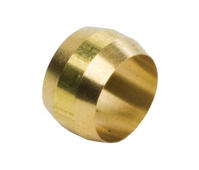
Compression is often the lowest-cost way to join copper without heat. A brass body, a nut, and a ferrule or olive compress against the tube to create a mechanical seal. It is common in accessible water lines, air lines, fuel lines, instrumentation, and repair work where a torch is impractical. The method is forgiving in tight spaces, but it is not careless work. Cut the tube square, deburr the inside and outside, keep the end clean, insert it fully, and tighten to the fitting maker’s specification. A crushed ferrule or a tube that is not fully seated can hold at first and weep later.
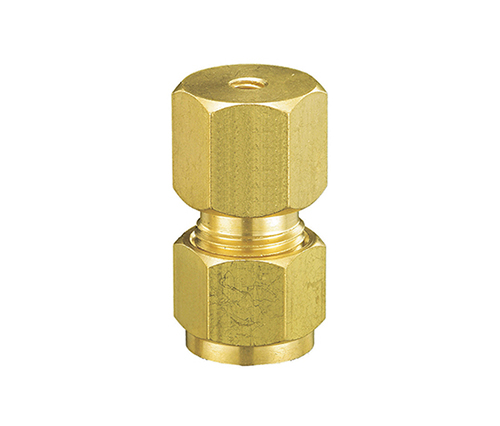 1/4 NPT Compression Double Male Connector for Fog SystemsFor accessible compression tube joints, compare this 1000 psi fog-system connector's copper, stainless, and brass material options and O-ring choices.View Product →
Compression is a poor match for badly bent tube, severe vibration without support, buried joints, or thin-wall tube outside the fitting’s listed range. It also depends on the tube being dry and free of scale at the sealing point. For a repair in a damp cabinet, dry the tube and inspect it before assembly. If the copper is pitted or oval, cut back to sound tube rather than forcing the fitting.
Push-fit fittings are the fastest option in many repair situations. A stainless grab ring, a collet, and an O-ring hold and seal the tube with hand pressure. That speed is useful in occupied buildings, tight chases, and emergency repairs. The trade-off is discipline. Mark the insertion depth, cut square, deburr, and push until the tube reaches the stop. Use the correct demount clip or release tool; do not twist or lever the fitting. Confirm that the fitting is listed for the tube material, the medium, and the pressure-temperature range. Push-fit is not a universal answer for gas, steam, or damaged tube, and O-ring compatibility matters with oils, chemicals, and some treated water. For buyers comparing push-to-connect brass fittings, the approval document and tube compatibility chart are more important than the catalog photo.
Press-connect fittings use a tool to compress a fitting body around the tube, with an O-ring providing the seal. The result is fast, repeatable, and clean in buildings where a flame is a liability. Hospitals, schools, hotels, and occupied commercial spaces often prefer it for that reason. The hidden cost is the tool and the training. A press joint is only as good as the jaw, the calibration, the insertion depth, and the approved fitting-tube combination. Miss the press, use the wrong jaw, or press a fitting that is not fully seated, and the mistake may not show until the system is charged. Press is not a “no-skill” method; it is a different skill with different failure points. It also needs a leak test like any other joint.
Flare connections are common in refrigerant, fuel, and higher-pressure tube work where a mechanical joint is accepted. The tube is cut square, deburred, and flared to the correct cone angle, then tightened to a specified torque. A poor flare cracks, leaks, or restricts flow. Flare is not a general substitute for potable-water soldering unless the code and fitting listing allow it. For refrigeration and similar systems, the tube preparation and torque matter as much as the fitting. SAE flare fittings are one family within that broader mechanical-joint category.
 OEM 432 SAE 45° Brass Union Flare FittingFor refrigerant and fuel flare joints, check this UL-listed SAE 45° brass union's long nut and available 1/4 to 5/8 in. sizes.View Product →
Brazing and welding remain the right choice for permanent high-temperature or high-pressure copper joints, especially in refrigeration. They require a permit, fire watch, purge, and enough skill to avoid overheating the tube. Cold adhesive bonding exists in limited niches, but it is not a general replacement for soldered or brazed copper in potable water or high-pressure systems.
Before choosing a method, confirm the facts that an inspector or maintenance engineer will ask for:
A low-cost fitting that fails a code check is not low cost. It becomes a removal, rework, and liability problem.
The shelf price is only one number. Compression usually has the lowest fitting cost but depends on careful tube preparation. Push-fit saves labor in tight spaces but costs more per fitting. Press-connect has a high tool cost and higher fitting cost, yet it can win on labor, schedule, and hot-work avoidance. Flare and brazing depend heavily on operator skill. For procurement, ask for dimensional drawings, material reports, thread standards, pressure ratings, and batch traceability. Mixed standards, missing certificates, and undocumented O-ring materials create rework risk that outweighs a small price difference. A brass fittings manufacturer should be able to match the fitting to the tube, the medium, and the installation method, not just quote a part number.
The best alternative to sweating copper pipe is the one that fits the medium, the pressure, the space, the skill on site, and the inspection rules. Start with approvals and tube condition, then compare labor, tooling, and rework risk. A clean compression joint, a correctly seated push-fit, a verified press, and a properly torqued flare can all be reliable—but only when the installer treats the fitting as a system, not as a shortcut.
Add:Xingzhong Road DianKou Town Zhuji City Zhejiang Province China
Mob: 0086-139 8951 3573
Tel: 0086-575-87560582
Fax: 0086-575-87560582
E-mail:[email protected]

 英语
 西班牙语