24Hours Tel
0086-139 8951 3573
Free Inqiry
E-mail:[email protected]
24Hours Tel
0086-139 8951 3573
Free Inqiry
E-mail:[email protected]
Imagine a maintenance technician standing next to a packaging line. A nylon air line needs to reach a pressure switch, but the area is crowded and there is no gas torch within reach. Soldering would melt the tube, and a threaded pipe connection would require a perfectly cut pipe. The technician picks up a brass pipe compression fitting, slides the nut and ferrule onto the tube, and tightens two wrenches. Ten minutes later the line is sealed and the machine is back in service.
This is the real value of pipe compression fittings: they deliver a leak-tight, separable connection without heat, without heavy tools, and without specialized skill. This guide explains what they are, how they work, how to choose the right type, and how to avoid the most common installation and sourcing mistakes.
A pipe compression fitting is a mechanical connector that joins two lengths of tube or attaches a tube to a fitting port. It works by squeezing a ring, called a ferrule, tightly around the outside of the tube. Unlike soldered or welded joints, it does not require heat. Unlike push-to-connect fittings, it does not rely on an O-ring alone; the main seal is a controlled radial compression on the tube wall.
The basic construction is simple: a fitting body with a tapered seat, a threaded compression nut, and one or two ferrules. The body has an internal passage that allows fluid to flow. The nut pushes the ferrule into the seat when tightened. The ferrule then deforms and grips the tube.
| Component | Function |
|---|---|
| Fitting body | Provides the sealing surface and the connection to the port or another fitting. |
| Compression nut | Applies axial force to the ferrule when tightened. |
| Ferrule | Deforms around the tube to create a mechanical grip and a seal. |
Brass is the most common material because it machines well, resists corrosion in air and water service, and works with copper, nylon, stainless steel, and other tube materials. Nickel-plated brass gives a cleaner appearance and improved corrosion resistance. Stainless steel fittings are used in chemical, food, and marine environments.
The seal depends on controlled deformation. When the nut is turned, its internal shoulder pushes the ferrule forward. The body's tapered seat presses the ferrule inward. The ferrule, which is usually made of hardened brass or stainless steel, flows radially into the tube surface. This creates two important contact zones: the leading edge of the ferrule seals against the body seat, and the inner bore grips the tube wall.
A single ferrule design uses one ring for both gripping and sealing. It is simple and economical, and it works well for moderate pressure and low vibration. A two-piece ferrule design uses a back ferrule and a front ferrule. The back ferrule pushes the front ferrule inward with greater mechanical advantage, producing a stronger grip on the tube. Two-piece designs are preferred for high-pressure instrumentation, hydraulic lines, and applications with vibration or thermal cycling.
| Feature | One-piece ferrule | Two-piece ferrule |
|---|---|---|
| Grip on the tube | Moderate grip | Stronger, more controlled grip |
| Sealing | Good for moderate pressure | Better for high pressure and vibration |
| Installation | Simpler assembly | Requires careful alignment of back and front rings |
| Reusability | Usually limited | Front ferrule can be replaced; tube end may need re-cutting |
Ferrule shape also matters. Symmetrical ferrules can be installed in either orientation, which helps in tight spaces. Asymmetrical ferrules have a specific front and back and must be oriented correctly. Always check the manufacturer's drawing before assembly.
The correct tightening method is based on distance, not just torque. A typical rule is to tighten the nut by hand until it stops, then turn the nut one quarter to one half turn with wrenches. The exact value is defined by the manufacturer and may change with tube material and wall thickness. Over-tightening can cave in a thin tube or strip the ferrule. Under-tightening leaves the ferrule partially deformed, and the joint will leak under pressure.
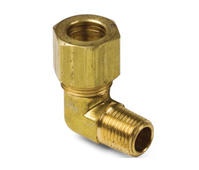
The most common type is the compression male connector. It has a shaped body with a male pipe thread on one end and a compression socket on the other. It is used to attach a tube to a valve, manifold, pump, or pressure switch. The male thread can be NPT, BSPP, BSPT, or metric, depending on the port.
The compression female connector replaces the male thread with a female thread. It is useful when connecting to a male-threaded pipe stub or an existing fitting.
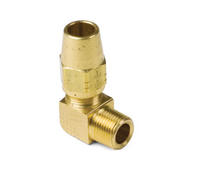
For direction changes, compression elbows are available in 45-degree and 90-degree configurations. A compression tee is used to split a straight run into a branch line. Tees can be equal bore or reducing, with different outlet sizes.
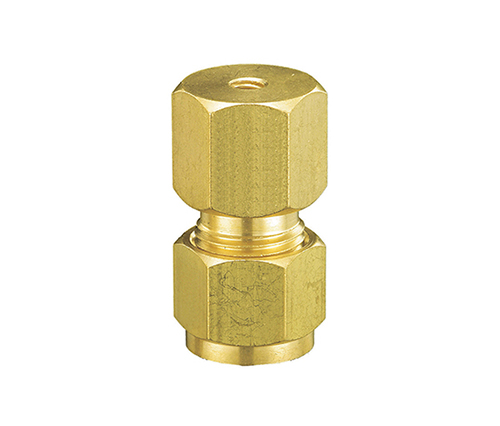 1/4 NPT Compression Double Male Connector for Tube SystemsThis double male connector joins two compression fittings end to end, making it easy to remove or reconfigure tube sections. Its copper construction suits fog systems and high-pressure lines rated to 1000 psi.View Product →
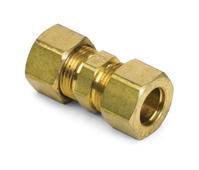
A compression union joins two tubes end to end. Both ends of the union body accept a nut and ferrule, allowing two compression sockets to be connected. Unions make it easy to remove a section of line without cutting the tube.
A bulkhead compression fitting passes through a panel or tank wall. It has a threaded portion that mounts on the panel and a compression socket on one or both sides. Bulkhead fittings are common in coolant reservoirs, pneumatic enclosures, and filter housings.
Reducers connect a larger tube to a smaller tube. They are essential when a supply line steps down to an instrument branch. Less common but still useful are cross fittings, which join four lines, and compression plug fittings, which close an unused socket.
All of these body types are available with different end connections. When ordering, verify the tube size on the compression side and the thread type on the port side. Mixing a 6 mm tube with a 1/4 in. thread is normal, but mixing a 6 mm tube with a 1/4 in. compression socket is not.
Brass is the default choice for pipe compression fittings. It offers good corrosion resistance in water, oil, and clean air, and it is easy to machine into precise shapes. For potable water systems, lead-free brass grades are required in many countries. Stainless steel is selected when the fluid is corrosive, the line is washed down with chemicals, or a higher temperature rating is needed. Plastic fittings are used when weight reduction or electrical insulation is important, but they have lower mechanical strength.
| Material | Corrosion resistance | Maximum temperature | Typical applications |
|---|---|---|---|
| Brass | Good for water and air | Roughly 150 C | Pneumatics, water lines, fuel lines |
| Stainless steel 304 / 316 | Excellent for chemicals and salt | Over 200 C for continuous service | Instrumentation, food, marine |
| Polypropylene / PVDF | Excellent for acids and ultrapure water | 60 C to 100 C | Chemical dosing, pure water systems |
Thread standards are a common source of field failures. NPT is a tapered thread used widely in North America. BSPT is a tapered British standard pipe thread. BSPP is a parallel British standard thread that seals with an O-ring or washer. Metric straight threads appear in European and Asian hydraulic equipment. The thread angle for NPT is 60 degrees; for BSP it is 55 degrees. Forcing an NPT male into a BSPP female can create a false fit that leaks after a few heat cycles.
Pressure ratings are never derived from the fitting alone. They depend on the tube material, tube wall thickness, fitting material, ferrule design, and temperature. A brass compression fitting on heavy-wall stainless steel tubing can handle very high pressure, while the same fitting on a thin nylon tube is limited to a few hundred kilopascals. Always check the manufacturer's pressure table, not a generic online rating.
When a fitting is marked with a pressure rating on the body, the marking usually refers to the fitting body itself, not the assembled joint with a specific tube. Confirm the rating with the supplier.
Certification matters in safety-related installations. For general industrial use, look for ISO 9001 manufacturing, material certificates, and dimensional inspection reports. In commercial vehicle air brake systems, fittings must meet DOT requirements and carry the DOT mark. For pipe compression fittings, an SAE, ASTM, or ISO design reference is useful but not always legally required.
Compression fittings are forgiving, but only if the tube is prepared correctly. Follow this sequence to avoid leaks and rework.
Over-tightening is the most common installation error. The ferrule collapses too far, the tube wall caves inward, or the nut splits. A severely over-tightened fitting can seal initially but fail on the next thermal cycle because the metal has yielded. If you need to know exactly how far to turn the nut, use a marker line on the nut and body.
Compression fittings are partially reusable. You can loosen the nut to rotate a fitting body without removing the tube. If you pull the tube completely out of the socket, the ferrule will stay compressed and will not seal again with the same grip. Replace the ferrule or cut off the old one and install a new ferrule before reassembly.
In high-vibration equipment, add a pipe clamp near the fitting to support the tube. Compression fittings are not designed to support the weight of long unsupported tubes. For moving machine parts, also check the manufacturer's guidance on vibration resistance.
Compression fittings appear wherever smooth metal or hard plastic tube must be connected in a reliable and separable way. The largest usage is in pneumatic systems. Factory air lines, packaging machines, and automated production cells use compression fittings with nylon, polyurethane, and copper tubing. The ability to remove a line without cutting makes maintenance faster.
In hydraulic systems, compression fittings are used on low-pressure return lines, drain lines, and pilot lines. They are not intended for high-pressure hose ends, but they perform well below a few hundred bar when the tube is thick-walled metal. For medium-pressure circuits, you can combine compression fittings with hydraulic adapters and connectors to match different thread systems.
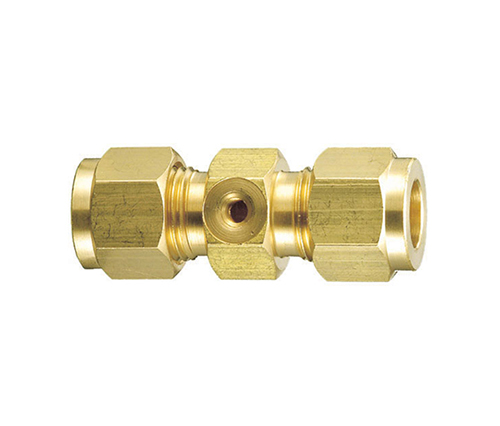 1000 PSI Fog Compression Tee Fitting for Branch LinesThis tee splits a straight compression run into a branch line while handling pressures from vacuum to 1000 psi. It suits fog systems and industrial applications where reliable sealing and compact installation are needed.View Product →
Instrumentation and analytical equipment depend on small compression fittings. A pressure transmitter on a sealed oil line often uses a 6 mm or 1/4 in. compression connection on stainless steel tubing. Because the joint is made without heat, the metallurgy of the tubing remains unchanged and the system stays free of oxidation.
Water treatment and beverage equipment are also strong application areas. Lead-free brass compression fittings connect reverse osmosis membrane housings, water filters, and chilled water dispensers. Stainless steel compression fittings handle washdown stations and dairy lines where caustic cleaners are used.
In automotive and mobile equipment, nylon fuel and vapor lines frequently use compression-type connectors. Commercial vehicle air brake systems are a specialized case; they usually use DOT-approved push-in connectors rather than general-purpose compression fittings. Compression fittings still appear in tachograph drives, air horns, and accessory circuits. In spray nozzles and cooling systems, a compression union or tee provides a clean way to take off a branch line.
Chemical process plants use stainless steel compression fittings on small-bore tubing for pressure impulses and analyzer lines. Because the lines are often far shorter than a pipe run, a few fittings are all that is needed, and the absence of welding on site reduces fire risk in hazardous areas.
To understand the sweet spot of compression fittings, compare them with the other joining methods used on tube and pipe.
Push-to-connect fittings use a collet and an O-ring. They are extremely fast to install, but the O-ring limits temperature and chemical compatibility, and the maximum pressure is usually lower. Flare fittings require the tube to be flared into a cone shape with a flaring tool. They can handle higher pressure and vibration, but the tube must be soft enough to flare and the process is more involved. Threaded pipe connections are strong but need tapered thread sealant or a sealing washer, and they are difficult to align without leaking. Soldered or brazed connections are permanent and strong but need a heat source and can distort thin tube.
| Method | Sealing principle | Tools required | Reusable | Typical pressure range |
|---|---|---|---|---|
| Compression | Ferrule deformation | Two wrenches | Yes with new ferrule | Medium to high |
| Push-to-connect | O-ring and collet | No tools | Usually yes | Low to medium |
| Flare | Cone seal | Flaring tool, wrench | Yes | High |
| Threaded pipe | Thread sealant | Pipe wrench | Depends on application | High |
| Soldered / brazed | Metallic bond | Heat source | No | Very high |
There are also situations where compression fittings are the wrong choice. Do not use them on thin-wall soft plastic tube that the ferrule can crush. Do not use them in a high-vibration line without clamping. Do not use them if the tube has an oval cross-section or a scratched surface. The ferrule needs a round, clean surface to grip properly.
The selection process starts with the outside diameter of the tube. Compression fittings are classified by the tube OD they accept: a 6 mm fitting fits 6 mm tube, a 1/4 in. fitting fits 1/4 in. tube. Do not order by the internal bore of the tube or by the pipe thread size alone. A 6 mm fitting can have a 1/8 in. male thread, a 1/4 in. male thread, or a 10 mm metric thread; the thread must be specified separately.
After the tube OD, check the wall thickness. Thin-wall tube may not produce enough contact area for the ferrule. Thick-wall tube can handle higher pressure but may require a different ferrule style. The fitting catalog lists a recommended wall thickness range for each socket.
Tubing from different sources may have the same nominal OD but different wall thickness. A fitting designed for a heavy wall may not collapse enough onto a thin wall tube, so the joint can pull out under pressure.
Choose the body material based on the fluid and the environment. Brass is suitable for air, water, oil, and many chemicals. Stainless steel is needed for caustic fluids, saltwater, and high-temperature service. If the fitting contains a plastic sealing ring, check its temperature and chemical compatibility as well.
Verify the thread type with a gauge. NPT, BSPT, BSPP, and metric straight threads look similar to the eye but have different pitch and thread angle. A wrong match can seal for a few minutes and then leak as temperature changes. When in doubt, send a sample of the mating port to the supplier.
Consider the operating environment beyond the basic pressure rating. Vibration, thermal cycling, steam cleaning, and UV exposure all affect the fitting. Nickel-plated brass resists corrosion better than bare brass. Stainless steel nuts are better on washdown equipment than zinc-plated carbon steel nuts.
Check certifications and test reports. For industrial safety, request material certificates and pressure test data. For DOT-regulated air brake systems, require a DOT mark and documentation. For food and beverage contact, use lead-free brass or stainless steel with a conforming surface finish.
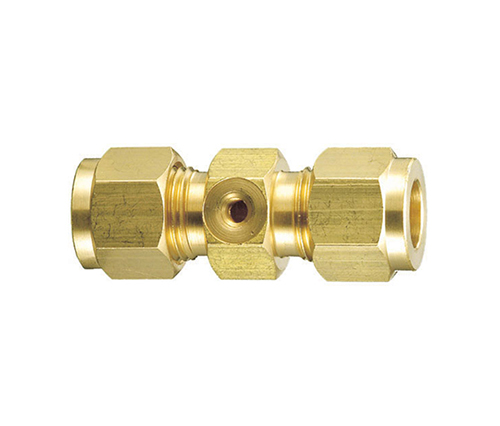 Brass Straight Compression Double Nozzle for FoggingThis brass double nozzle is designed for fog systems, producing dense fog in low- to medium-pressure applications. It handles abrasive or atomized materials and can be customized with different threads for your equipment.View Product →
If you are designing a new system, the fastest way to begin is to download a compression fitting catalog in PDF form and match your tube sizes, thread standards, and pressure requirements to the specification table. A well-organized catalog also shows the dimensional drawing and the part number structure.
A low price for a brass fitting can look attractive until it leaks on the production line and costs an hour of downtime. Buyers should evaluate the actual capability of the factory, not just the photos in a catalog.
First, verify the material grade. A credible manufacturer can state the exact brass grade, such as HPb59-1 or C36000, or the stainless steel grade 304 or 316. If the supplier avoids the question, the part may be made from unknown recycled alloy with poor machinability and inconsistent corrosion resistance.
Second, inspect the threads. The thread should be clean, sharp, and burr-free. An NPT thread must have a taper of 1 in 16; a BSPP thread is parallel. A supplier that does not use thread plug gauges or ring gauges will not catch a worn die before a thousand parts ship.
Third, measure the ferrule dimensions and hardness. The ferrule is the heart of the fitting. If it is too soft, it will not bite into the tube; if it is too hard, it may fracture during installation. A supplier should provide the ferrule drawing, hardness range, and a functional test report.
Fourth, check the plating and passivation. Nickel plating should be smooth and free of blisters. Poorly cleaned brass can cause plating to peel within weeks. Stainless steel fittings should be passivated to avoid rusting from carbon steel contamination.
Factories with real process control can offer OEM services, custom part numbers, and batch-level test reports. At Zhejiang Qinwei Fluid Technology Co., Ltd., for example, metal fittings are checked against SAE, DOT, and ASTM requirements, and SGS inspection reports are available for every batch. This type of traceability is essential for companies that export machines and need to file documentation for end customers.
Buying conditions also matter. Factory-direct suppliers can quote lower prices because there is no trading company margin. They can also provide a standard brass fittings price list, adjust packaging, and accommodate small orders. No-minimum-order policy is useful for prototyping and maintenance spares, while volume discounts make large projects economical.
Finally, ask about documentation. A packing list with lot numbers, a certificate of conformity, and photos of the final inspection are valuable during an audit. If a failure occurs, the lot number lets the factory investigate and correct the root cause.
Compression fittings are a practical and reliable method for joining metal and hard plastic tubing in low, medium, and even moderate high-pressure service. They require no heat, use ordinary wrenches, and allow the connection to be reopened when maintenance demands it. At the same time, they are not a one-size-fits-all product. The ferrule style, tube material, thread type, and installation torque all determine whether a joint will remain tight for years or leak during commissioning.
To get the best result, start with the outside diameter of your tube and the exact thread of the port. Choose a material compatible with the fluid, temperature, and cleaning chemicals. Then select a supplier that can prove its quality with material certificates, gauge inspections, and batch traceability. With that approach, you will avoid most of the field failures that occur in new installations.
If you are planning a new line or replacing an existing leak, review the compression fitting specification tables before you place an order. The ten minutes you spend confirming tube size and thread type will save considerably more time later.
Add:Xingzhong Road DianKou Town Zhuji City Zhejiang Province China
Mob: 0086-139 8951 3573
Tel: 0086-575-87560582
Fax: 0086-575-87560582
E-mail:[email protected]

 英语
英语 西班牙语
西班牙语