24Hours Tel
0086-139 8951 3573
Free Inqiry
E-mail:[email protected]
24Hours Tel
0086-139 8951 3573
Free Inqiry
E-mail:[email protected]
A dripping joint under a kitchen sink usually tells a simple story: the copper line was cut slightly out of square, the ferrule was the wrong size, or the nut was tightened until the brass stopped arguing. For a copper water line, a compression fitting is still one of the most practical ways to join tube to a stop valve, filter head, ice maker, or appliance inlet. It is compact, serviceable, and does not need soldering equipment. The catch is that it seals by deformation, not by thread friction. The nut pulls the ferrule onto the copper tube, the ferrule compresses, and the fitting body gives it a shoulder to crush against. If the tube outside diameter, ferrule, nut, and body are not matched, or if the tube is scratched or not fully inserted, the joint may hold at first and weep later. The practical rule is simple: buy the fitting by tube outside diameter, prepare the copper square and clean, insert it fully, and tighten with two wrenches using a controlled turn rather than force.
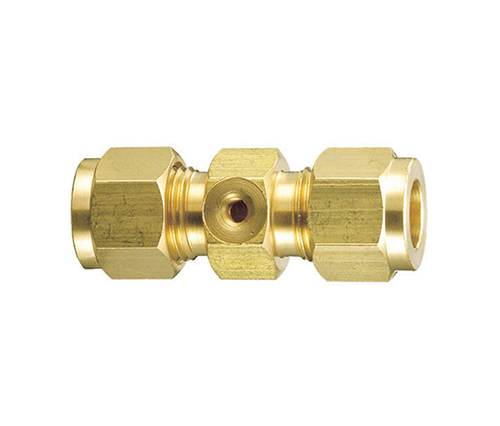
A brass compression fitting for copper water line service usually has four working parts: the body, the nut, the ferrule, and the copper tube itself. The body contains the internal shoulder and the threaded section. The nut provides the mechanical pull. The ferrule, often called an olive in some markets, is the soft metal ring that deforms against the tube. The tube is not merely a passage for water; it is part of the seal. When the nut is tightened, it pushes the ferrule forward. The ferrule compresses radially onto the copper surface and axially against the body shoulder. That creates two sealing zones: a radial grip on the tube and a face seal at the body. The threads do not seal water. They only generate clamping force.
This matters because many leaks blamed on “bad fittings” are actually installation errors. A ferrule that is forced onto an out-of-round tube cannot close evenly. A nut tightened without holding the body can twist the fitting and distort the ferrule. A tube inserted only partway can leave the ferrule gripping air instead of copper. For potable water, the fitting should also be made from a suitable lead-free brass or another approved material, and it should be rated for the line pressure and temperature. A compression joint on a copper water line is reliable when those conditions are respected; it is not a repair clamp for crushed tube or a substitute for a threaded adapter that matches the valve.
The most common sizing mistake in copper water lines is treating the nominal label as the actual outside diameter. Plumbing copper pipe is often called by nominal size, while copper tubing for appliances and instrumentation is often called by outside diameter. A 1/2-inch nominal copper pipe has a 5/8-inch outside diameter. A 3/8-inch outside diameter copper tube is a different product from a 3/8-inch nominal pipe. The ferrule must match the real tube surface it grips, not the label on the shelf. Before ordering, check the tube OD with a caliper, confirm the thread standard on the valve or adapter, and review the fitting dimension sheet rather than guessing from a photo. The compression fitting dimension sheet is useful for checking tube OD, nut thread, and body length before a batch order.
| Copper line called | Actual outside diameter | Typical fitting label | What to verify |
|---|---|---|---|
| 1/4 in. OD tubing | 1/4 in. OD | 1/4 in. compression | Common on ice makers and small filters; easy to crush if over-tightened. |
| 3/8 in. OD tubing | 3/8 in. OD | 3/8 in. compression | Frequent fixture and appliance size; do not substitute a 1/2 in. nominal fitting. |
| 1/2 in. nominal copper pipe | 5/8 in. OD | 1/2 in. compression | The label follows pipe size; the ferrule must fit 5/8 in. OD tube. |
| 3/4 in. nominal copper pipe | 7/8 in. OD | 3/4 in. compression | Larger nuts need support and a steady two-wrench pull to avoid body rotation. |
Compression fittings reward a slow first minute. The goal is a clean, round, fully inserted tube with the ferrule square to the body. A practical sequence works for most copper water line joints:
For a new joint on small copper water line, a common starting point is finger-tight plus about one-quarter to one-half turn. Larger fittings and different ferrule designs may need a different value, so the manufacturer’s instruction should win over habit. The feel matters: the nut should become firm and then stop progressing smoothly. If it keeps turning with little resistance, the threads may be mismatched, the nut may be cross-threaded, or the ferrule may have slipped out of position.
Over-tightening is not a safety margin. It can split the ferrule, collapse a thin-wall tube, strip brass threads, or leave a permanent groove that makes the joint hard to reseal. Under-tightening is also a failure, but it usually shows up as a slow weep at the first pressure test rather than a sudden burst. After tightening, pressurize the line and inspect the joint with a dry paper towel or a clean cloth. A single drop after several minutes is still a leak. If the joint weeps, a small additional turn of about one-eighth may stop it, but repeated tightening is a warning sign. If the leak continues, disassemble the joint, inspect the ferrule and tube, and replace the ferrule rather than crushing it further.
Thread sealant belongs on the male pipe threads when the fitting adapts to a female threaded valve or port, not on the ferrule or the compression nut threads. For potable water, use a sealant approved for the application and follow local code. Also support the copper line so the fitting is not carrying the weight of a filter housing, valve, or appliance hose. Vibration and side load can loosen a joint that was watertight at installation.
For a copper water line, the fitting body and ferrule should be compatible with potable water and with the copper tube. Lead-free brass is common in modern water-service fittings, but buyers should ask for the material declaration and any required potable-water listing rather than assuming that “brass” means suitable for drinking water. Pressure rating, temperature rating, and thread standard matter as much as the tube size. A fitting rated for compressed air may not be intended for continuous water service, and a fitting intended for a hydraulic line may have a different ferrule design. In repair work, the most common needs are straight connectors, elbows, tees, and adapters from compression to male or female pipe thread. A straight male connector is the usual endpoint at a stop valve, filter head, or appliance inlet, and it should be selected by tube OD and thread size.
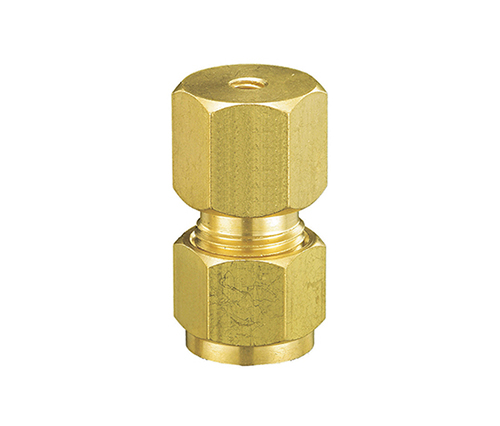 1/4 NPT Compression Double Male ConnectorCompression tube connector for fog, hydraulic, and pneumatic lines, offered in copper, stainless steel, or brass with vacuum-to-1000 psi rating.View Product →
A compression tee is useful when a single copper supply must feed two fixtures or when a branch is added without cutting in a larger manifold. The tee must be supported so that tightening one nut does not rotate the body and disturb the other joints. For tight cabinets and appliance recesses, a compact body and a nut that can be reached with a wrench matter more than a few millimeters of extra length.
 1000 PSI Fog Compression Tee FittingsCompression tee for fog systems and high-pressure projects, with copper or stainless steel bodies and options for 3/8 inch or 12 mm tubing.View Product →
Buyers sourcing for distribution or OEM assembly should also confirm the ferrule style. Some fittings use a separate brass ferrule; others use a captive ferrule or a different compression geometry. Mixing nuts, ferrules, and bodies from different product families can produce a joint that feels tight but does not seal. If the fitting is going into a potable-water appliance, request samples and run a pressure-hold test with the actual tube lot, because tube hardness and surface finish can vary between suppliers.
Compression is often the best balance for copper water line repair because it needs only a cutter, deburring tool, and two wrenches. Push-on fittings are faster and useful in tight spaces, but they rely on an O-ring and a gripping mechanism; the O-ring material and tube surface condition become long-term variables. Flare fittings are common in refrigeration and some appliance lines, but they need a flaring tool and a properly formed flare. Solder or braze joints are permanent and compact, but they require heat, flux, and protection of nearby materials. For a accessible shutoff or appliance connection, compression is usually easier to service. For a concealed line or a high-vibration installation, the decision should follow the manufacturer’s rating, local code, and the maintenance plan rather than speed alone.
A compression fitting looks simple, but a purchase order should be specific. For copper water line programs, confirm the following before approving a shipment:
For a distributor, the fastest way to reduce returns is to separate bins by actual tube OD, not only by nominal size, and to keep nuts and ferrules with their matching bodies. For an OEM, the critical step is validating the joint as an assembly: tube, fitting, torque, and support. A fitting that passes a bench test can still fail in a cabinet if the tube is side-loaded or the nut is installed with an impact driver.
A compression joint can be opened for service, but it should not be treated as a reusable connector in the same way as a threaded union. The ferrule is the sacrificial sealing element. Once it has been crushed, it may not grip a new tube position evenly. If a joint is opened, inspect the ferrule for cracks, scoring, and a deep groove. Replace the ferrule if there is any doubt, and cut the copper tube back behind the old compression mark if the surface is damaged. When reassembling, use the same sequence: clean tube, full insertion, hand-thread the nut, hold the body, and tighten to the manufacturer’s specification. If the tube end is too short to reach the body shoulder, do not try to bridge the gap with extra torque; add a proper extension or remake the line.
The practical rule for a compression fitting on a copper water line is not “tighten it until it stops leaking.” It is “match the ferrule to the tube OD, prepare the copper square and clean, insert it fully, and tighten with two wrenches to a controlled stop.” That approach solves the common leaks, protects the valve or appliance port, and leaves a joint that can be serviced later without cutting out half the cabinet. When the tube is damaged, the ferrule is wrong, or the threads do not match, no amount of tightening will turn a compression fitting into a reliable seal.
Add:Xingzhong Road DianKou Town Zhuji City Zhejiang Province China
Mob: 0086-139 8951 3573
Tel: 0086-575-87560582
Fax: 0086-575-87560582
E-mail:[email protected]

 英语
 西班牙语