24Hours Tel
0086-139 8951 3573
Free Inqiry
E-mail:[email protected]
24Hours Tel
0086-139 8951 3573
Free Inqiry
E-mail:[email protected]
An olive compression fitting is how most plumbers and maintenance engineers join copper, brass, or nylon tubing without soldering. The olive, known in North America as the ferrule, is the small metal ring inside the compression nut. When you tighten the nut, it presses the olive against the fitting body and bites into the tube surface, creating a mechanical seal that holds water, compressed air, or hydraulic oil. The system works well when everything matches: the tube diameter, the olive size, the nut torque, and the fitting material. That is also where most installations go wrong.
An olive is a soft metal ring, usually made from brass, copper, or stainless steel, that is compressed between the fitting body and the compression nut. It is also referred to as a ferrule or compression ring. The term "olive" is used throughout the UK and much of Europe; "ferrule" is more common in the US. In both cases, the component performs the same function: it holds the tube in place and creates two sealing surfaces, one between the olive and the tube, and another between the olive and the body's taper.
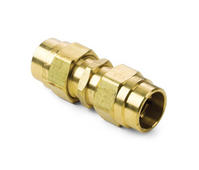
A brass compression fitting has three basic parts: the body, the olive, and the nut. The body has a tapered seat. The olive slides over the tube, then the nut threads onto the body. As you tighten the nut, it pushes the olive forward into the taper. The olive deforms slightly, grips the tube, and presses firmly against the body seat.
Two things happen at the same time. First, the inner edge of the olive bites into the tube wall, preventing the tube from pulling out. Second, the outer surface of the olive seals against the taper, keeping the medium from escaping. This sealing force is mechanical, not adhesive. That is why an olive fitting can be separated and reassembled, as long as the olive is in good condition and the tube is cut square.
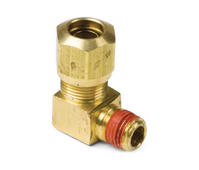
Compression fittings come in several configurations, each designed for a specific installation need. The most common types are:
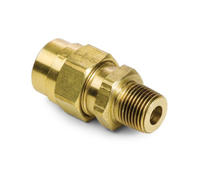
The male connector is the workhorse of compressed air, water, and low-pressure hydraulic systems. The compression end grips the tube, while the male thread screws into a tapped port. The thread standard, whether BSPP, NPT, or SAE, must match the port to avoid cross-threading or leaks.
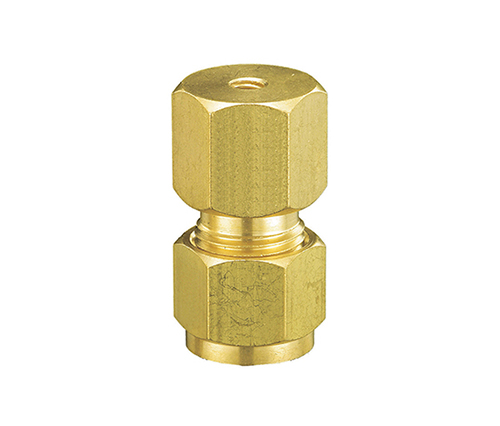 1/4 NPT Double Male Connector with Compression EndsThis connector features a 1/4 NPT male thread and compression ends, suitable for vacuum to 1000 psi. It fits standard tube sizes and is commonly used in fog systems, as mentioned in the surrounding text.View Product →
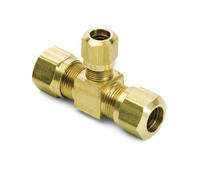
A compression tee is used when a line branches in two directions. In pneumatic systems, it is common to build a manifold with several tees, each supplying a different cylinder or valve.
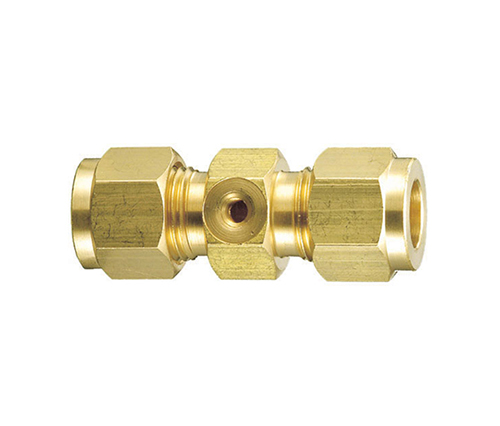 1000 PSI Fog Compression Tee Fittings for Branching LinesThis tee fitting is designed for fog systems, handling pressures from vacuum to 1000 psi. It allows branching in two directions, a common need in pneumatic manifolds as described in the context.View Product →
Choosing the right size is critical. The dimensions that matter are the tube outer diameter, commonly written as OD, and the thread size on the fitting. For metric tubes, common sizes are 6 mm, 8 mm, 10 mm, 12 mm, 15 mm, and 22 mm. For imperial tubes, the most common sizes are 1/4, 5/16, 3/8, 1/2, 5/8, and 3/4 inch.
| Tube OD (mm) | Tube OD (inch) | Thread (BSP) | Typical Application |
|---|---|---|---|
| 6 mm | 1/4 in | 1/8 to 1/4 in | Instrumentation, control lines |
| 8 mm | 5/16 in | 1/4 to 3/8 in | Pneumatic lines, cooling |
| 10 mm | 3/8 in | 1/4 to 1/2 in | Water lines, gas |
| 15 mm | 1/2 in | 3/8 to 3/4 in | Domestic plumbing |
| 22 mm | 3/4 in | 3/4 to 1 in | Main water supply |
Thread standards are equally important. BSP, British Standard Pipe, is common in the UK and Europe. NPT, National Pipe Taper, is used in North America. SAE standards are common in automotive applications. Mixing thread standards is one of the fastest ways to create a leak. Always confirm the thread type before ordering.
Brass is the standard material for most olive compression fittings because it offers good corrosion resistance, holds up well in water and compressed air, and can be deformed enough to create a seal without cracking. Copper olives are softer and easier to compress, but they are more easily damaged by repeated tightening. For general plumbing, pneumatic, and hydraulic work, brass is the best balance of cost and performance. The olive in a brass fitting is usually made from brass or copper, while the fitting body is forged from brass rod.
Installation is straightforward, but it pays to follow a sequence.
One note on reusability: once the olive has been compressed and then removed, it has already taken its final shape. Reusing it rarely produces a clean seal. Replace the olive with a new one if the joint has to be taken apart.
The most common failure in the field is over-tightening. When the nut is turned too far, the olive collapses into the tube, the tube wall is crushed, and the connection will almost certainly leak at higher pressure. The second most common mistake is using PTFE tape on the olive. An olive fitting is a mechanical seal, not a thread seal. PTFE tape on the compression threads does not help and can actually prevent the olive from seating correctly. A third mistake is installing a fitting without backing up the fitting body. If you tighten the nut while the body is free to spin, you will twist the copper or nylon tube and damage it.
Start from the application, not the product. Ask what medium will run through the line, what pressure and temperature it will see, and whether the connection will be subject to vibration or quick disconnection. For compressed air systems, a brass olive fitting is usually sufficient. For water, the same. For hydraulic and DOT air brake systems, you need a fitting that meets the relevant standard, such as SAE J512 for 45-degree flare, DOT FMVSS 571.106 for air brake fittings, or DIN 2353 for metric compression fittings.
The compression fittings available from LEGINES are manufactured from brass rod, machined to close tolerances, and tested to hold the required pressure without leaks. The product line covers male and female connectors, elbows, tees, unions, and nozzle fittings for industrial atomization systems. For any application that requires precision misting or fog delivery, the compression mechanical connection is the same, but the fitting body is designed around the nozzle.
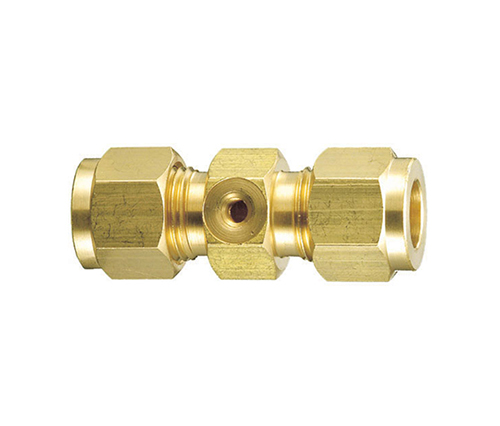 Brass Straight Compression Double Nozzle for Fog SystemsThis brass nozzle fitting provides a straight double nozzle for dense fog generation, working up to 1000 psi. It is suitable for low to medium pressure fogging applications, as noted in the surrounding article about precision atomization.View Product →
An olive compression fitting is a simple but precise component. Its performance depends on matching the olive to the tube, selecting the right thread standard, tightening to the correct torque, and using the correct material for the medium. If you keep those four variables under control, a brass olive fitting will give you years of leak-free service. The next time you are replacing a compression fitting, inspect the olive carefully, cut the tube square, and do not be tempted to over-tighten the nut. That is the fastest route to a connection that holds.
Add:Xingzhong Road DianKou Town Zhuji City Zhejiang Province China
Mob: 0086-139 8951 3573
Tel: 0086-575-87560582
Fax: 0086-575-87560582
E-mail:[email protected]

 英语
英语 西班牙语
西班牙语