24Hours Tel
0086-139 8951 3573
Free Inqiry
E-mail:[email protected]
24Hours Tel
0086-139 8951 3573
Free Inqiry
E-mail:[email protected]
A maintenance team replaces a 3/8 in copper air-brake line on a trailer, tightens every nut, and still finds a slow leak at the first cold-weather check. The thread is correct, the tube looks clean, and the fitting is marked DOT. The problem is usually not the catalog page; it is the joint system. Copper crimp fittings are often the right answer for speed and repeatability, but only when tube hardness, wall thickness, insertion depth, tool die, and standard are treated as one specification. The practical conclusion is simple: choose copper crimp fittings by circuit and standard first, then by size and price. That order prevents the most expensive outcome, a fitting that passes a bench test but fails in service.
Copper crimp fittings create a mechanical joint by compressing a metal sleeve or fitting body onto a copper tube with a matched press or crimp tool. The tool does not simply squeeze the part; it drives a controlled deformation that fills the gap between tube and fitting and produces a seal that resists vibration, thermal cycling, and pressure pulses. This is different from a compression fitting, where a nut draws a ferrule onto the tube, and different again from a flare or solder joint. Each method has a place, but they are not interchangeable in a specification.
The first selection question is not “what is the lowest price per piece?” It is “what does the circuit require?” A DOT air-brake copper line on a commercial vehicle has different acceptance criteria from a low-pressure water line or a hydraulic return. For air-brake work, buyers should look for DOT-marked products and a supplier that can connect the fitting to the relevant FMVSS 106 and SAE practices. For general copper tubing, tube temper and wall thickness matter as much as the fitting thread. A soft tube that deforms too easily may not hold the intended crimp; a hard tube that is outside the tool’s range may under-crimp or crack.
| Method | How it seals | Typical fit | Purchase watch-out |
|---|---|---|---|
| Copper crimp or press | Tool compresses fitting onto tube for a controlled mechanical seal | Repeatable assembly, vibration, air-brake and fluid lines | Tool die, tube hardness, insertion depth, and standard must match |
| Compression | Nut drives ferrule or sleeve against tube | Serviceable joints, small-batch repair, instruments | Over-tightening and ferrule reuse can cause leaks |
| Flare | Tube end is flared against a mating cone | SAE 45° and similar fluid systems | Flare angle, tube squareness, and nut torque control quality |
| Solder or braze | Filler metal bonds tube and fitting | Fixed plant piping and repair where heat is acceptable | Heat damage, fire risk, flux residue, and rework cost |
Copper crimp fittings are strongest where the installer needs a repeatable joint without open flame. That includes commercial vehicle air-brake copper tubing, compressed-air distribution, hydraulic return lines, cooling circuits, and some HVAC or water applications. In air-brake work, the fitting must survive pressure pulses, road vibration, and temperature swings, so the joint is only as good as the tube preparation and tool calibration behind it. A crimp that looks tight can still fail a leak-down test if the tube was cut at an angle or pushed in short of the marked depth.
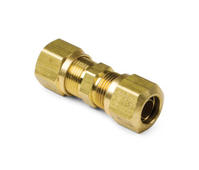
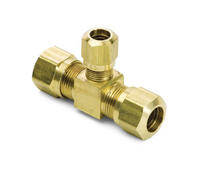
For DOT air-brake copper circuits, buyers often need a family of unions, connectors, elbows, and bulkhead fittings rather than a single part. A representative union such as the DOT copper union 1362x8 is a useful reference point when comparing insertion depth, thread type, and marking. Where a line passes through a frame or panel, a bulkhead union can reduce strain at the connection. Where a female thread transitions to a copper tube, a female connector may be the better catalog match. The key is to keep the whole circuit in one standard family so the installer is not mixing dies, thread forms, and insertion marks on the same truck.
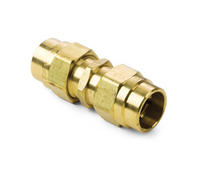
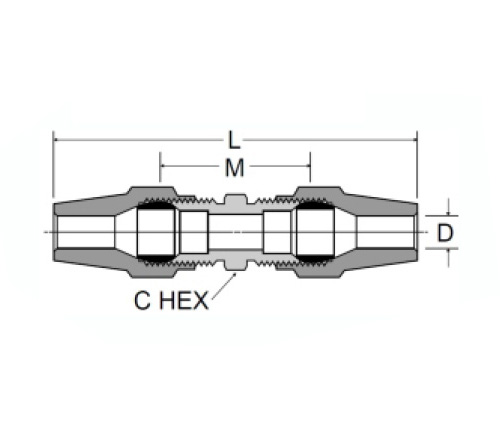 1362 DOT Air Brake Copper Union FittingReusable brass union meeting D.O.T. FMVSS571.106 and SAE J246, useful when standardizing DOT air-brake copper circuits across multiple tube sizes.View Product →
LEGINES supplies DOT air-brake copper tubing fittings alongside broader brass and copper connection ranges, which helps buyers consolidate a bill of materials without treating each line as a separate sourcing project. For teams that need a starting point, the DOT-approved air-brake fittings range is organized around the circuit rather than a single part number. That structure matters when a maintenance group is standardizing repair kits across tractors, trailers, and service vehicles.
The most common purchasing error is to specify “3/8 in copper” and assume every 3/8 in fitting, tube, and tool will work together. In practice, the specification needs tube outside diameter, wall thickness, temper, thread form, and the applicable standard. Air-brake copper tubing is often tied to SAE J246 or an OEM drawing, while general copper tube may reference ASTM B75, ASTM B88, or ASTM B280 depending on the application. DOT-marked assemblies are commonly evaluated against FMVSS 106 requirements and related SAE test practices. These are not decorative markings; they tell the buyer which test regime the part was designed to survive.
Thread form is the next trap. NPTF, SAE 45° flare, BSPP, and BSPT look similar in a photo but do not seal the same way. A BSPP male thread with a bonded washer is not a substitute for an NPTF dry-seal thread, and a 45° flare is not a 37° JIC flare. Buyers should require the supplier to state the thread standard, the tube standard, the pressure rating, and the temperature range on the quotation. If a catalog page only shows a size and a photo, the specification is incomplete. For copper crimp fittings, the tool die number and insertion depth should also be traceable to the fitting family.
A practical tolerance check is to measure ten tubes from the same lot. If the outside diameter or ovality varies beyond the fitting maker’s range, the crimp will vary with it. The same logic applies to cut quality: a tube cut with a dull wheel can leave a burr that prevents full insertion. A deburring step that is skipped on a busy service floor is a common cause of leaks that are blamed on the fitting. The fitting is only one part of the joint; the tube end is the other.
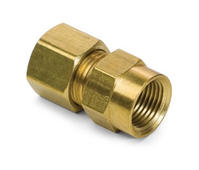
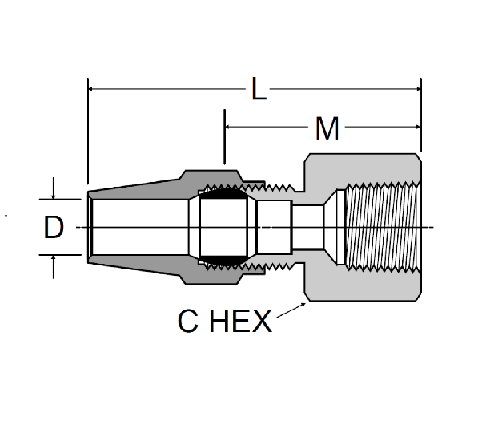 1366 Air Brake Copper Tubing Female ConnectorReusable brass female connector meeting D.O.T. FMVSS571.106 and SAE J246, offered in multiple tube-to-NPTF sizes for copper and supported nylon air-brake lines.View Product →
Most copper crimp fitting failures fall into four groups: wrong tube hardness, wrong insertion depth, wrong tool or die, and mixed thread standards. A fifth, less obvious risk is batch inconsistency. If the fitting body alloy, wall thickness, or plating changes between lots, the same tool setting may not produce the same crimp. Buyers who purchase by price alone often discover this only after a leak-down test or a warranty claim. A better approach is to ask for batch-level material or test reports, especially for safety-related air-brake circuits.
Another risk is reusing a fitting that was crimped once. Crimp joints are generally intended as permanent connections; removing and re-crimping the same fitting can compromise the deformation and seal. Repair kits should include new fittings and the correct tube section, not just a replacement nut. On the purchasing side, the supplier should be able to state whether the fitting is for a single crimp, whether it is removable, and what inspection method is recommended after assembly.
The installation sequence is short, but each step protects the next. Start with a square cut, deburr the inside and outside of the tube, and mark the insertion depth on the tube with a marker or depth gauge. Insert the tube fully into the fitting and confirm the mark is at the fitting shoulder. Select the correct die for the fitting and tube size, close the tool completely, and do not double-crimp to “make sure.” A second crimp can over-compress the joint and reduce its fatigue life.
Tool calibration deserves more attention than it usually receives. A press tool that is out of calibration can produce a joint that looks correct but fails under vibration. Service teams should log calibration dates and die condition, and they should replace worn dies rather than compensate with extra pumping or a second crimp. The same discipline applies to the tube cutter: a sharp wheel and a reaming step cost less than a comeback.
A good buying decision starts with the circuit map. List each connection by tube size, thread, pressure, temperature, and standard, then group the parts by fitting family. This makes it easier to see where a union, connector, elbow, or bulkhead fitting is genuinely different and where a common family can cover several lines. It also exposes mixed standards before they reach the service floor. For export buyers, ask for the price list, the standard marking, and the dimensional drawing in one package so the engineering and purchasing teams are working from the same data.
LEGINES positions its brass and copper fittings around factory sales pricing, OEM support, and no minimum order quantity, which suits distributors and maintenance groups that need mixed small batches rather than a single high-volume part. The useful question is not whether a supplier can ship one box; it is whether the supplier can keep the same insertion depth, thread form, and marking across repeat orders. A dimensional catalog or PDF selection sheet is a practical control document for that purpose. The DOT air-brake copper fittings PDF is one example of a reference that can be attached to an RFQ so the quote is tied to a defined part family.
Copper crimp fittings earn their place when the job needs a clean, repeatable joint and the buyer treats the tool, tube, and standard as part of the product. The fitting alone cannot compensate for a short insertion, a wrong die, or a mixed thread form. Start with the circuit and the standard, confirm the tube and tool range, and require traceability on the parts that affect safety. That approach keeps the focus on total joint reliability rather than the lowest piece price, which is where copper crimp fittings usually prove their value.
Add:Xingzhong Road DianKou Town Zhuji City Zhejiang Province China
Mob: 0086-139 8951 3573
Tel: 0086-575-87560582
Fax: 0086-575-87560582
E-mail:[email protected]

 英语
 西班牙语