24Hours Tel
0086-139 8951 3573
Free Inqiry
E-mail:[email protected]
24Hours Tel
0086-139 8951 3573
Free Inqiry
E-mail:[email protected]
A contractor replaces a run of soft copper air line with a brass compression fitting, tightens it until it feels right, and the joint is weeping within six weeks. Another installer joins a brass stop valve to hard copper tube using the same two metals and the connection outlasts the building. The metals were never the variable. Copper and brass sit close to each other on the galvanic series, so a brass fitting threaded onto copper tube does not build the aggressive galvanic cell you get when brass meets steel or aluminium. What separates a dry joint from a leaking one is alloy grade, tube temper, thread standard, connection style and installation torque, roughly in that order of importance.
That is the short answer this guide works from: specify copper and brass pipe fittings on paper, not on colour. The metal family is compatible. The details are where money disappears, whether that means a container of fittings that will not pass a thread gauge, a flare that splits at 150 psi, or a plumbing line that dezincifies in three summers.
The material below is written for people who actually specify and buy these parts: maintenance planners, plumbing and HVAC contractors, hydraulic technicians, and purchasing staff sourcing from a brass fittings manufacturer. It covers the alloy grades behind common fitting numbers, the connection styles that suit copper tube and brass bodies, the thread standards that cause the most expensive mistakes, and the checks that catch a bad lot before it reaches a job site.
One framing point before the detail. A fitting is sold as a part but performs as a system. Its pressure rating only means something in combination with a specific tube, a specific installation torque and a specific medium. A 300 psi brass compression fitting on thin-wall copper tube in a vibrating compressor room is not a 300 psi joint. Keep that in mind and most of the guidance below reads as common sense rather than engineering theory.
Galvanic corrosion needs three conditions at once: two metals with a meaningful potential difference, an electrolyte bridging them, and a large area of the more noble metal exposed to a small area of the less noble one. Copper and brass fail the first condition. In the practical galvanic series, copper, brass and bronze sit within a few tens of millivolts of each other in most natural waters. A brass fitting on a copper tube is not a galvanic couple in any usable sense, which is why plumbing codes do not ask for a dielectric union at that joint.
The pairs that do cause trouble are the ones where a copper alloy meets steel, iron or aluminium. Brass is cathodic to steel, so in a mixed joint the steel side corrodes, and because the brass area is often large relative to the steel area, the attack concentrates and moves quickly. That is the failure behind rusted-out galvanised nipples threaded into brass valves, and behind aluminium heat exchanger connections that pit within a season. The fix is a dielectric union, a plastic-lined nipple, a polymer-bodied transition fitting, or simply a length of flexible hose that breaks the metallic path.
| Joint | Galvanic risk | What usually happens | Recommended action |
|---|---|---|---|
| Brass fitting on copper tube | Very low | No measurable galvanic attack; failures are mechanical or chemical instead | No dielectric union needed |
| Brass on bronze or gunmetal | Very low | Stable joint in fresh and salt water | Standard assembly practice |
| Brass on carbon steel or cast iron | Moderate to high | Steel side corrodes; thread roots pit first | Dielectric union, plastic-lined nipple or hose break |
| Brass on galvanised steel | High | Zinc coating consumed rapidly, then base steel rusts | Avoid direct connection in wet service |
| Brass on aluminium | High | Aluminium pits deeply at the contact point | Isolate with a barrier fitting or polymer body |
| Copper on stainless steel | Low to moderate | Generally acceptable; risk rises with chloride content and stagnation | Monitor in chloride-rich or stagnant systems |
Dezincification is the corrosion mode that does real damage to brass in water service, and it has nothing to do with the copper tube next to it. In high-zinc brasses, zinc can leach out of the alloy, leaving a porous copper sponge behind. There are two forms: plug type, which perforates in a localised spot, and layer type, which attacks broadly and leaves a reddish surface. Warm, stagnant, chloride-bearing water is the classic trigger, which is why domestic hot water dead legs and irrigation lines that sit pressurised for months are the usual crime scenes. Higher zinc content means higher susceptibility, so a free-cutting grade with roughly 35 percent zinc is more exposed than a naval brass or a dezincification-resistant grade.
Mitigation is straightforward once the risk is recognised. Specify dezincification-resistant brass, tin-bearing brass, silicon brass or a bronze for potable and warm-water duty. Keep water chemistry inside the limits the fitting maker states, particularly chloride and pH. Flush dead legs. And if the system will sit stagnant for long periods, expect to pay for the better alloy rather than replace the line later.
Lead is the second chemistry issue and the one that stops shipments at customs. Potable water fittings sold in the United States and the European Union are subject to lead-free definitions based on weighted average lead content, generally 0.25 percent, with compliance demonstrated through test reports to standards such as NSF/ANSI 372 alongside NSF/ANSI 61 for the material itself. The classic free-cutting brass used for decades is not compliant for potable service. Lead-free alternatives exist and machine differently, so tooling, feeds and cycle times all change. When a supplier says lead free, ask for the UNS alloy number and a batch test report, not just the phrase.
Brass is a family, not a material. The Unified Numbering System designations that appear on mill certificates and purchase orders tell you what the fitting will do under pressure, in water, and on a machining line. Five grades cover most of what a buyer will encounter in copper and brass pipe fittings.
C36000 is the free-cutting brass that set the 100 percent machinability reference for the industry. It cuts fast, holds crisp threads and produces a clean surface. It is also the grade that carries the highest lead content and a high zinc content, so it is the least suitable for potable water and the most exposed to dezincification. Its natural home is air, oil, fuel and general industrial service where potable compliance is not a factor.
C37700 is a forging brass. Because it is hot forged rather than cut from bar, the finished fitting has a dense, pore-free structure with a grain flow that follows the shape. That matters for flare nuts, hose fittings and anything that sees pressure cycling or vibration. Lead content is lower than the free-cutting grade, hot working is excellent, and the secondary machining of threads and seats is where the tolerance is held.
C46400, naval brass, adds a small amount of tin to improve resistance to seawater and brackish water. It costs more and machines a little differently, but for marine, dockyard, irrigation and pump-side duty the extra resistance pays for itself the first time a line is opened after five years in service.
Silicon brass and DZR grades, including the C69300 family and dezincification-resistant compositions, are the modern answer for potable water and warm-water plumbing. They are lead-free or near lead-free, resist dezincification, and are specified where a code official or a utility will ask questions. They machine differently from free-cutting brass, with shorter tool life and tighter process windows, which is why they cost more and why the better suppliers control their process data closely.
C12200 is the copper side of the joint: phosphorus-deoxidised copper tube, roughly 99.9 percent copper with a small phosphorus addition for deoxidation. It is the softer half of the assembly, it conducts heat extremely well, and it work-hardens every time it is bent or flared. That work hardening is the reason a flare made on an already-bent section of tube cracks.
| UNS grade | Common name | Typical make-up | Best used for | Watch out for |
|---|---|---|---|---|
| C12200 | DHP copper tube | About 99.9% Cu with 0.02 to 0.04% P | Water, refrigeration, air brake and instrument tubing | Work hardens when bent; soft temper deforms under clamps |
| C36000 | Free-cutting brass | About 61.5% Cu, 3% Pb, balance Zn | Machined fittings for air, oil and fuel | Not for potable water; dezincification risk in aggressive water |
| C37700 | Forging brass | About 59% Cu, 2% Pb, balance Zn | Forged flare nuts, hose fittings, pressure parts | Requires forging tooling; higher set-up cost at low volume |
| C46400 | Naval brass | About 60% Cu, 0.75% Sn, balance Zn | Marine, brackish water, pump and dock service | Higher material cost; not a substitute for proper water chemistry control |
| C69300 type | Silicon brass, lead-free | Cu-Zn-Si with low or no lead | Potable water, warm-water plumbing, code-sensitive work | Different machining behaviour; verify batch test reports |
The practical consequence is that two fittings that look identical on a shelf can behave completely differently in service. A machined C36000 elbow in an air line is a sensible, economical part. The same elbow in a hot water line with 200 mg/L chloride is a scheduled replacement. Asking for the alloy number is the single fastest way to tell which one you have been quoted.
Brass fittings reach their final shape by two routes, and the route affects the properties as much as the alloy does. Machined fittings are cut from bar stock on automatic lathes. The process gives tight concentricity, clean thread forms and excellent repeatability in small and medium batches, and it allows internal geometries that are awkward to forge. The limits are material cost, since a large share of the bar becomes chips, and porosity risk if the incoming bar is not clean. A reputable maker verifies bar stock and controls chip removal so that internal passages do not retain swarf.
Forged fittings start as a billet heated and shaped in a die, then go through secondary machining for threads, seats and O-ring grooves. Forging closes internal porosity, aligns grain along the load path and produces a denser part, which is why forged bodies dominate where pressure, vibration and fatigue matter. The tooling cost only makes sense at volume, and thread quality still depends on the machining step, so forging alone is not a guarantee of a good fitting.
On the copper side, temper and wall thickness decide as much as the fitting does. Copper water tube is classified by wall thickness as Type K, L or M, with K the heaviest and M the lightest, and it is supplied drawn hard or annealed soft. Annealed tube bends and flares without cracking and is the normal choice for refrigeration, instrument lines and air brake runs where the tube has to follow a chassis or a wall. Hard-drawn tube holds a straight run, supports clamps better and is preferred for exposed work and risers. The failure that catches people is thin-wall Type M tube used with a compression fitting designed for heavier wall: the ferrule cannot develop enough grip, and the joint creeps under pressure or pulls apart when the line is disturbed.
Threaded connections bring their own wall requirement. When a brass fitting with tapered threads is tightened into a pipe, the thread is cut or formed into the wall, and the wall has to be thick enough to carry the resulting hoop stress. That is one reason transitions from copper tube to threaded pipe are usually made through a brass adapter with a proper shoulder rather than by threading thin tube. If a joint has to be threaded, use a pipe or a fitting body designed for it, not a tube end.
Connection style is the decision that most directly determines whether a joint can be serviced, how much vibration it tolerates, and what pressure it holds. Copper and brass pipe fittings are available in five families, and each has a natural application range.
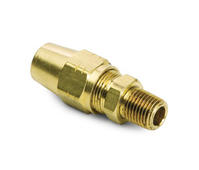
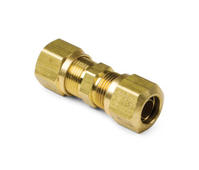
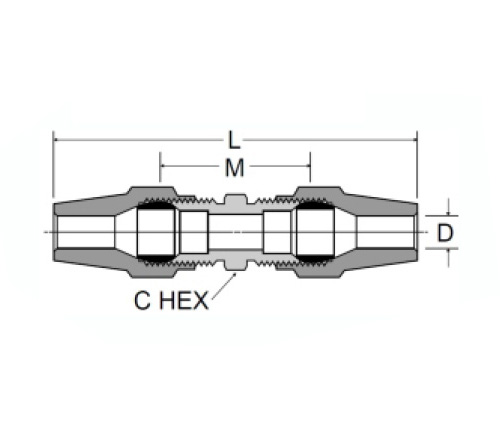
A brass compression fitting seals by squeezing a ferrule, often called an olive, onto the outside of the tube as the nut is tightened. The ferrule deforms into the tube surface and into a matching cone in the body, producing a metal-to-metal seal that needs no heat and no special tools beyond two wrenches and a tube cutter. Single-ferrule designs dominate small-bore work; two-ferrule designs, usually with a front ferrule for sealing and a back ferrule for grip, tolerate higher pressure and vibration.
The installation details decide the outcome. The tube must be cut square, deburred inside and out, and round within the tolerance the maker states. A tube that has been squeezed in a vice, kinked during bending, or scored by a dull cutter will not seal no matter how much torque is applied. Insertion depth matters: the tube must seat fully against the shoulder inside the body, which can be checked by marking the tube at the nut depth before assembly. And the joint should be tightened to the maker's torque or turn count, not to feel, because a brass nut and ferrule will happily deform past the elastic range and then relax.
Compression is the right choice for copper tube in water, oil and low-pressure air service where the line needs to be assembled on site and taken apart occasionally. It is the wrong choice for continuous vibration, for repeated remake cycles, and for thin-wall tube without a support insert. Plastic or soft-metal tube needs a stiffener sleeve inside it before the ferrule is tightened.
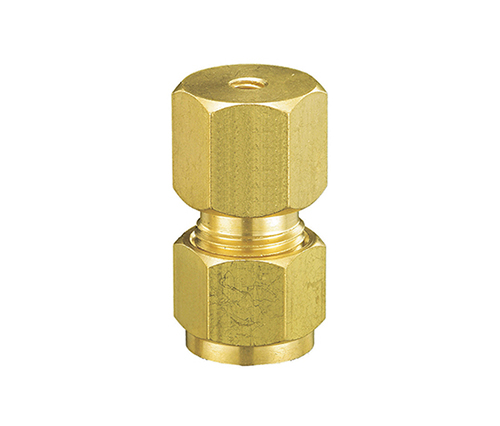 OEM 1/4 NPT Compression Double Male ConnectorCompression fitting for fog, hydraulic and pneumatic lines, available in copper, stainless steel or brass with vacuum-to-1000 psi service and seal options.View Product →
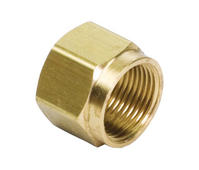
Flare fittings seal at a cone. The tube end is expanded into a flare with a flaring tool, and the nut pulls the flare against a matching seat in the body, so the seal is metal to metal at the cone and the nut carries the load. Nothing is crushed onto the outside of the tube, which means the joint can be disassembled and remade several times without replacing a ferrule.
The flare angle is where mistakes happen. SAE 45-degree flare is the traditional brass and copper arrangement for automotive, fuel, oil and low-pressure hydraulic work. JIC 37-degree flare is the higher-pressure steel world. The two look similar, are dimensionally close at small sizes, and will partially engage before leaking or cracking the seat. Inverted flare, where the cone is inside the nut rather than on the tube, appears in automotive brake and fuel lines. Never mix angles, and never force a nut that seats too early.
Flare quality depends on tube condition. Annealed copper flares cleanly; work-hardened copper cracks at the cone rim, and the crack is often invisible until pressure arrives. Cut the tube square, deburr, slip the nut on before flaring, and use a flaring tool that produces the correct angle and diameter for the fitting series. Over-flaring, where the flare is too large for the seat, produces a joint that bottoms on the nut instead of the cone and leaks every time. Brass SAE flare fittings are widely used in refrigeration and automotive work for exactly this reason, and the selection detail is worth checking against a catalogue before ordering.
A properly made flare joint, in the right alloy and at the right torque, is one of the most reliable connections available in small-bore copper work. A badly made one is a guaranteed callback.
For buyers who need to match an existing line, the brass flare range and its dimensional data are usually the fastest way to confirm the series, angle and thread before placing an order. A catalogue check takes minutes; a wrong flare angle costs a service call.
Where the joint has to be reopened for maintenance, flare is usually the better answer than compression. Where the tube is thin-wall or the installer is working in a tight space without room for a flaring tool, compression wins. Neither is universally superior.
Related reading on this site covers SAE 45-degree flared tube fittings in brass, including the nut and seat dimensions that distinguish the series.
Sweat fittings are copper, not brass, and they seal by capillary action: solder melts and is drawn into the clearance between tube and fitting socket. Lead-free solder is now standard for potable work, with silver-bearing brazing alloys used where temperature or pressure rules out solder, as in refrigeration and medical gas lines. The joint is permanent, cheap per unit and mechanically strong, but it needs heat, flux and a clean surface, and it cannot be assembled near anything heat-sensitive.
Sweat is the default for concealed plumbing and for copper lines that will never be opened. It is the wrong choice for air brake systems, for anything that will be disassembled, and for locations where a hot work permit cannot be obtained. Flux residue has to be flushed, because it is mildly corrosive and will attack the tube from the inside over years.
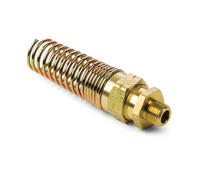
Barbed fittings rely on the elasticity of the hose: the barb grips the bore, and a clamp supplies the radial force that keeps it there. Push-on brass fittings are a variant designed for specific hose constructions, where the hose is pushed fully over the barb and the hose's own reinforcement provides the grip without a clamp. Both are low-cost, fast to assemble and easy to inspect, and both depend entirely on using the correct hose, cut square and pushed to the full depth marked on the barb.
Push-in fittings work differently: an O-ring seals against the tube outside diameter and a collet with stainless teeth grips it, so the tube is inserted and released with a ring rather than a tool. These dominate pneumatic systems and appear in DOT air brake lines in nylon and copper variants. The seal depends on tube outside diameter tolerance and surface finish, so scored or ovalised tube leaks, and a tube that is not pushed fully home will hold at low pressure and release under vibration.
Threaded connections transfer the seal to the thread or to a face, depending on the standard. Tapered threads, both NPT and BSPT, seal by interference along the thread flank, assisted by sealant or tape. Parallel threads, BSPP and metric, cannot seal on the thread at all and need a washer, an O-ring or a bonded seal at a machined face. Confusing the two families is the most expensive thread mistake in the trade, and it gets its own section below.
| Connection | Typical tube or hose | How it seals | Service character | Common mistake |
|---|---|---|---|---|
| Compression | Copper tube, some plastic with insert | Ferrule crushed onto tube | Water, oil, low-pressure air; limited remakes | Under- or over-torque; thin-wall tube; tube not fully seated |
| 45-degree flare | Annealed copper, brass tube | Tube flare against cone seat | Fuel, oil, air, low to medium pressure; remade easily | Mixed with 37-degree; cracked flare from hard tube |
| Sweat or braze | Copper tube | Capillary filler metal | Permanent, high integrity, no disassembly | Wet tube, dirty surface, unflushed flux |
| Barb or push-on | Rubber or reinforced hose | Barb grip, clamp or hose tension | Coolant, air, water; low pressure | Wrong hose type; not pushed to full depth |
| Push-in | Nylon, copper or polymer tube | O-ring plus collet grip | Pneumatics, air brake; fast assembly | Scored or oval tube; incomplete insertion |
| Threaded NPT or BSPT | Pipe or fitting body | Thread interference plus sealant | General service; dependent on correct thread form | NPT mated to BSP; excessive sealant; over-torque |
Thread confusion causes more scrap, more leaks and more arguments than any other issue in this product category. The reason is that two thread families look almost identical at the small sizes most fittings use, and one of them will partially engage the other, which is worse than not engaging at all.
NPT, the American tapered pipe thread, has a 60-degree thread angle, a 1:16 taper and a defined thread count per inch for each nominal size. It seals on the thread flank, which is why PTFE tape or a thread sealant is required. NPTF is a dryseal variant with controlled root and crest interference that can seal without sealant, but it is not interchangeable with NPT in high-pressure work.
BSPT, the British standard tapered pipe thread under ISO 7, has a 55-degree angle and a 1:16 taper. BSPP, the parallel version under ISO 228, has the same 55-degree angle but no taper, and seals on a washer or an O-ring face. The critical trap is that one-half inch and three-quarter inch NPT and BSP threads share the same nominal thread count of 14 threads per inch. They will start to engage, feel tight, and then either leak or split the female component when the installer keeps going. One inch is worse still: 11.5 threads per inch on NPT against 11 on BSP, which produces cross-threading that destroys both parts.
Metric threads add a third family. ISO 6149 and DIN 3852 ports use parallel metric threads with an O-ring or a bonded washer at the face, and they are common on European and Asian hydraulic and pneumatic equipment. They will not seal with tape, and they will not seal if the wrong washer is omitted.
| Standard | Thread angle | Taper | Sealing method | Interchangeable with the others? |
|---|---|---|---|---|
| NPT (ASME B1.20.1) | 60 degrees | 1:16 tapered | Thread interference plus sealant | No |
| NPTF | 60 degrees | 1:16 tapered | Dryseal by root and crest interference | No; not a field substitute for NPT |
| BSPT (ISO 7) | 55 degrees | 1:16 tapered | Thread interference plus sealant | No; partial engagement with NPT at 1/2 and 3/4 inch |
| BSPP (ISO 228) | 55 degrees | Parallel | Washer, O-ring or bonded seal at a face | No; will not seal on the thread |
| Metric (ISO 6149, DIN 3852) | 60 degrees | Parallel | O-ring or bonded washer at the port face | No |
Verification is a workshop discipline, not a visual skill. Use calibrated thread plug and ring gauges for incoming inspection, keep a known-good sample of each standard on the bench for comparison, and label bins by standard rather than by size. When a female port has to accept a different standard, use a documented adapter rather than a wrench and hope.
 Legines 3326 Brass Male Close Nipple Pipe FittingAll-brass close nipple for air, water, fuel and hydraulic lines, made to SAE J530/J531 dryseal thread standards with sizes from 1/8 to 3/4 in.View Product →
The same discipline applies to port preparation. Sealant tape applied too thickly can hydraulic-lock a tapered thread and crack the female body before the joint is even tight. Liquid sealant applied to the first two thread turns migrates into the system and blocks orifices. Both failures are avoidable with a controlled amount of the right product and a torque value taken from the fitting maker's table.
A purchase order for copper and brass pipe fittings usually cites one or more standards. Knowing what each one controls makes it easier to check a quotation and to reject a substitution.
One practical note on documentation. A certificate of conformity issued against a standard is not the same as a test report on the actual batch. For a first order, ask for batch-level third-party reports, typically SGS or an equivalent laboratory, covering composition and, where relevant, dimensional checks and pressure testing. For repeat orders, agree a sampling plan and a retention period so that a future claim can be traced back to a heat number.
Every fitting has a published pressure rating, and almost every field failure happens because that rating was applied to the wrong assembly. The working rating of a joint is the lowest rating of its parts: the fitting body, the tube, the ferrule or flare, the seal and the thread engagement. A high-pressure body on thin-wall tube is limited by the tube. A high-pressure tube with a low-pressure ferrule is limited by the ferrule. The number on the box describes the strongest link, not the chain.
Temperature derates brass and copper assemblies in ways that are easy to ignore. Brass strength falls as temperature rises, and sustained temperatures above roughly 150 to 200 degrees Celsius take the material out of the range where standard plumbing and pneumatic ratings apply. Elastomer seals are usually the tighter constraint: nitrile, EPDM and fluorocarbon O-rings have quite different upper limits, and a fitting rated for 200 degrees Celsius with a standard nitrile O-ring is a 100 degree fitting in practice. Below freezing, water left in a copper line splits the tube, and no fitting specification prevents that.
Water hammer and surge deserve more attention than they get. A valve closing quickly in a long line can produce a transient pressure several times the steady-state value, and the fitting that fails is usually the one with the least margin, often a compression nut on thin-wall tube. Slow-closing valves, arrestors, and adequate clamping are the countermeasures. Vibration is the other slow killer: a brass flare nut on an unsupported copper line will fatigue at the tube flare after enough cycles, and the crack looks like corrosion until it is examined closely.
Media compatibility is a separate check. Ammonia and ammonium compounds attack copper and brass, so refrigeration systems using ammonia do not use copper tube. Acetylene reacts with copper to form an explosive compound, which is why copper and high-copper brasses are excluded from acetylene service. Strong acids, hypochlorite at high concentration, and some fire-protection additives are also aggressive to copper alloys. Most of these exclusions are well documented and are worth confirming before the first length of tube is cut.
Application decides specification faster than any other input. The same brass fitting family appears across very different duties, and each duty emphasises a different property.
Air brake lines combine nylon tubing, copper tubing, rubber hose and a large number of small brass fittings in an environment of constant vibration, road salt, temperature swing and a safety-critical duty cycle. System pressure typically sits around 100 to 130 psi, but the consequences of a leak are out of proportion to the pressure. Fittings in this service are usually D.O.T. marked, built to the relevant SAE dimensions, and validated by vibration and pressure cycling rather than by static burst alone.
Copper variants are preferred where heat or routing geometry rules out nylon, and push-in variants are preferred where assembly speed and serviceability matter. The recurring field issues are incomplete tube insertion, tube that has been scored during routing, and mismatched replacement parts, which is why buying from a documented D.O.T. range with published dimensions is worth the small price premium. A dedicated range of DOT-approved air brake fittings covers the nylon, copper, hose and push-in variants that a truck or trailer line needs.
 1362 Brass Air Brake Copper Connector UnionD.O.T. FMVSS571.106 and SAE J246 brass union for copper air brake, coolant and fuel lines, reusable and available with pre-applied sealant or nickel plating.View Product →
Low-pressure hydraulic return lines, pilot lines and pneumatic circuits are natural territory for brass. Pneumatics in particular runs on push-in fittings with polymer or copper tube, where assembly speed matters more than ultimate pressure. Hydraulic work at higher pressure usually moves to steel, but brass adapters and flare fittings remain common at gauge points, test ports and small-bore control lines.
Plumbing is the most regulated application and the least forgiving of alloy shortcuts. Lead-free composition, dezincification resistance and third-party material certification all matter, and inspectors increasingly ask for documentation. The right specification is a lead-free brass or bronze body with a defined alloy number, not an unmarked fitting described as brass.
Refrigeration uses annealed copper tube almost exclusively, joined by flare fittings at serviceable points and by silver brazing everywhere else. System pressures with modern refrigerants run well above plumbing levels, so flare geometry, nut quality and tube temper all matter. A flare made on work-hardened tube is the most common leak source on a newly installed system.
Irrigation, marine, water treatment and general industrial work spread across a wide pressure range but share a corrosion exposure. Naval brass, bronze and coated fittings appear here, and dezincification resistance is often more important than pressure capability. Garden hose, nozzle and fogging systems use the same material logic at much lower pressure, with the added constraint that the parts sit outdoors and in sunlight for years.
Most failures in copper and brass pipe fittings fall into a small number of patterns. Recognising the pattern shortens diagnosis considerably, because the visible damage is often not where the cause sits.
| Failure | Typical root cause | Prevention |
|---|---|---|
| Compression joint weeps at the nut | Tube not seated to the shoulder, or under-torque | Mark insertion depth; use torque or turn count from the maker |
| Split flare or cracked cone | Work-hardened tube, over-flaring, or wrong flare angle | Anneal before flaring; use the correct tool and series; do not mix 45 and 37 degree parts |
| Nut cracks during tightening | Tapered thread over-torqued with excess sealant | Two turns of tape maximum, correct torque, thread gauge incoming parts |
| Reddish, porous surface with pinholes | Dezincification in warm, stagnant, chloride-bearing water | Specify DZR or silicon brass; flush dead legs; control water chemistry |
| Steel or iron side corroded at the joint | Galvanic couple with brass in a wet system | Dielectric union or non-metallic break |
| Leak that appears only under vibration | Fatigue at flare or ferrule; unsupported tube | Clamp at intervals, add a vibration loop or flexible section, avoid rigid long runs |
| Threads bind after one turn | NPT mated to BSP, or damaged thread from previous assembly | Gauge and label by standard; replace damaged fittings instead of re-cutting |
| Tube pulls out of push-in fitting | Incomplete insertion, scored tube, or wrong tube outside diameter | Cut square, mark depth, inspect tube surface, use the specified tube grade |
Two patterns are worth extra attention because they are frequently misdiagnosed. The first is dezincification, which is often reported as a defective batch when the real cause is water chemistry plus a high-zinc alloy that should never have been specified for that line. The second is fatigue at a flare, which looks like a material crack but is the predictable result of an unsupported copper run in a vibrating installation.
Buying copper and brass pipe fittings well is mostly a matter of asking the same questions every time, in the same order. The list below reflects what tends to go wrong when a step is skipped.
For buyers working with an overseas manufacturer, four capability questions separate a trading desk from a factory. Ask to see the production equipment for the specific process, whether that is multi-spindle machining, hot forging or automated assembly. Ask which standards the quality system is certified to and what the certificate scope actually covers. Ask how OEM parts are handled: who owns the tooling, how first articles are approved, and how changes are notified. And ask for a named technical contact who can read a drawing, because the person who can answer a tolerance question is usually not the person who quotes the price.
A manufacturer with its own machining and assembly, a documented standard range and batch-level test reports will answer those questions without hesitation. One that cannot should be treated as a reseller, which is fine if that is what the purchase needs, but it changes the risk calculation on delivery and on claims.
Copper and brass pipe fittings are a mature product category, and that is exactly why the differences between suppliers show up in the details rather than in the concept. The metals work together; a brass fitting on copper tube creates no galvanic problem worth designing around. What does decide the outcome is whether the alloy suits the water, whether the thread standard matches the port, whether the tube temper suits the connection, and whether the installer tightened to a value rather than to a feeling.
The buying decision follows the same logic. Specifying by alloy number, thread standard, tube dimension and test documentation removes most of the risk before a single part is shipped, and it makes a claim possible if something does go wrong. Price still matters, and a factory-direct quotation with clear quantity breaks is a legitimate way to control cost, but only after the specification is settled. A cheaper fitting that fails a thread gauge or dezincifies in two summers is not a saving; it is a deferred cost with interest attached.
Start with the tube, then the medium, then the connection style, then the thread, then the alloy. In that order, almost every choice in this category makes itself.
Add:Xingzhong Road DianKou Town Zhuji City Zhejiang Province China
Mob: 0086-139 8951 3573
Tel: 0086-575-87560582
Fax: 0086-575-87560582
E-mail:[email protected]

 英语
 西班牙语