24Hours Tel
0086-139 8951 3573
Free Inqiry
E-mail:[email protected]
24Hours Tel
0086-139 8951 3573
Free Inqiry
E-mail:[email protected]
Brass fittings are mechanical connectors made from a copper and zinc alloy used to join, redirect, terminate, or regulate the flow of fluids and gases in piping systems. They are the dominant fitting material in residential and commercial plumbing fittings, potable water systems, HVAC installations, gas distribution, fire suppression lines, and industrial fluid systems because brass combines corrosion resistance, machinability, lead-free compliance, and long service life in a single material that outperforms plastic at elevated temperatures and outperforms steel in wet oxygen-rich environments.
Brass fittings serve five core functional roles in any piping system:
The global brass fittings market was valued at approximately USD 14.2 billion in 2023 and is forecast to reach USD 19.8 billion by 2030, driven primarily by infrastructure development, potable water network upgrades, and growth in HVAC and gas distribution installations in emerging markets. This scale reflects the irreplaceable position of brass as the material of choice across plumbing fittings worldwide.
Understanding the full range of brass fitting types is essential before specifying any plumbing or piping system. Each type solves a specific geometric or functional challenge in the system layout.
Brass Couplings are straight connectors used to join two pipe sections end to end in a continuous run. They are available in three variants:
Threaded brass fittings in the coupling category follow NPT (National Pipe Taper) or BSP (British Standard Pipe) thread standards, with NPT dominant in North America and BSP dominant in Europe, Australia, and most Asian markets. A standard 1/2 inch NPT brass full coupling for residential potable water systems is one of the highest-volume individual SKUs in the global plumbing fittings supply chain.
Brass Elbows redirect pipe runs at a specific angle, with 90 degree and 45 degree as the two standard configurations. A 90 degree elbow (also called a street elbow in its compact one-end-male configuration) turns the pipe at a right angle. A 45 degree elbow provides a gentler direction change that reduces turbulence and pressure drop compared to a 90 degree turn.
For high-flow applications such as main supply lines where minimizing pressure loss is a priority, a 45 degree elbow reduces the equivalent pipe length friction loss by approximately 40% compared to a 90 degree standard elbow of the same nominal size. In a residential potable water system with a 3/4 inch supply main, replacing each 90 degree brass elbow with a 45 degree plus a short section of pipe can reduce total system pressure loss by 8% to 12%, meaningfully improving flow rate at fixtures in multi-story buildings.
Brass Elbows are available with all combinations of male and female NPT or BSP threaded ends, as well as solder ends (for copper pipe systems) and compression ends (for PEX and copper compression connections).
Brass Tees are T-shaped fittings with three openings: two in line and one at 90 degrees to the run. They are the primary means of creating branch connections from a main pipe run in any plumbing fittings system. Variants include:
Brass Valves represent the most functionally diverse category within the brass fittings family. As a corrosion-resistant metal with a service life in potable water exceeding 50 years when correctly specified, brass is the material of choice for valves across all scales of plumbing and HVAC systems.
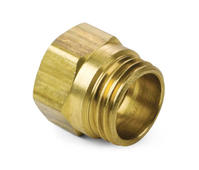
Threaded brass fittings use tapered (NPT/BSPT) or parallel (BSP) threads to create pressure-tight mechanical joints when assembled with pipe thread sealant tape (PTFE) or pipe thread compound. They are the dominant connection method in all brass fitting categories because they can be assembled and disassembled with standard hand tools without special equipment or soldering skills.
NPT threads per ASME B1.20.1 taper at 1/16 inch per inch of thread length, meaning the joint tightens mechanically as it is turned and the taper creates the seal when combined with PTFE tape or sealant. A correctly assembled 1/2 inch NPT threaded brass fitting with two wraps of PTFE tape is rated for a working pressure of 600 psi at ambient temperature, far exceeding the requirements of any residential or light commercial potable water or gas application.
Brass compression fittings for PEX and copper pipe are designed for tool-free or minimal-tool installation where soldering is not possible or not preferred. The compression mechanism works by compressing a soft brass or copper ferrule (olive) against the pipe outer diameter as the compression nut is tightened, creating a leak-free mechanical seal without any thread sealant or heat.
For PEX pipe systems, brass insert fittings with stainless steel clamp rings or expansion rings are the dominant connection method, but compression-style brass fittings are also used in accessible locations where future disassembly for maintenance may be required. Brass compression fittings for PEX and copper are rated for working pressures of 200 to 300 psi at 73 degrees Fahrenheit (23 degrees Celsius) and typically carry a 200 psi rating at 180 degrees Fahrenheit (82 degrees Celsius), making them suitable for both cold and hot supply lines in residential potable water systems.
Understanding the difference between brass cap and plug fittings is practical knowledge for anyone working on plumbing systems. The distinction is which end of the joint each fitting closes:
Both cap and plug fittings are used during pressure testing of new plumbing systems. A system is capped or plugged at all open ends, pressurized to 1.5 times the working pressure, and held for a defined period (typically 15 to 30 minutes under most plumbing codes) to verify that all joints are leak-free before walls are closed or insulation is applied.
The advantages of using brass fittings in piping systems are practical and measurable rather than merely theoretical. Brass has been the preferred plumbing fitting material for over 150 years, and its continued dominance in the face of competition from stainless steel, plastic, and composite alternatives reflects genuine performance advantages in the majority of applications.
Brass is a corrosion-resistant metal in water systems because the zinc content of the alloy forms a passive zinc oxide surface layer that resists further corrosion in the pH range of 6.5 to 8.5 that characterizes most municipal potable water supplies. Copper in the alloy further enhances corrosion resistance by contributing a protective cupric oxide patina. Properly specified brass fittings in residential potable water systems have documented service lives of 40 to 70 years without failure, as evidenced by brass fittings recovered from buildings constructed in the early twentieth century that show minimal material loss and retain full pressure-holding capability.
This contrasts with plastic fittings, which are susceptible to UV degradation in exposed locations, thermal creep under sustained load at elevated temperatures, and chemical attack from chloramine disinfectants increasingly used in municipal water treatment. CPVC plastic fittings exposed to chloramine concentrations above 4 mg/L show measurable stress cracking within 10 to 15 years in some water chemistry conditions, while brass fittings in the same systems show no degradation.
Durable plumbing fixtures made from brass maintain dimensional stability and mechanical integrity across the temperature range of typical plumbing systems. Brass alloys used in plumbing fittings (typically C36000 free-machining brass or lead-free C69300 brass for potable water) have a tensile strength of 45,000 to 58,000 psi and a yield strength of 18,000 to 45,000 psi depending on temper. This mechanical strength means that brass fittings resist deformation under the mechanical loads of pipe installation, thermal expansion cycling, and water hammer events that would crack plastic fittings or deform soft copper connections.
Water hammer pressure spikes in residential plumbing systems can reach 150 to 300 psi above normal operating pressure in the milliseconds following rapid valve closure (such as an automatic washing machine valve or dishwasher solenoid). Brass fittings and threaded brass fittings absorb these transient pressure spikes without failure, whereas plastic push-fit connections in the same location have been documented to fail under repeated water hammer events in field studies conducted by plumbing research organizations.
One of the practical advantages of brass as a fitting material is its exceptional machinability. Free-machining brass (C36000) has a machinability rating of 100 on the standard scale, making it the reference material against which all other metals are compared. This means that custom brass fittings manufacturers can produce complex fitting geometries with tight dimensional tolerances at high production rates using standard CNC turning and milling equipment, without the specialized tooling or slow cycle times required for stainless steel or titanium machining.
The practical consequence is that custom brass fittings manufacturers can produce OEM-specific configurations in quantities as low as 500 to 1,000 pieces with lead times of 4 to 8 weeks, making custom brass fittings accessible to equipment manufacturers, HVAC system designers, and specialty plumbing product companies that cannot justify the tooling investment for injection-molded plastic alternatives at low to medium volumes.
Brass fittings are uniquely compatible with the full range of pipe materials used in modern plumbing systems. A single brass fitting can connect copper pipe (via solder or compression), PEX pipe (via insert and clamp or expansion ring), CPVC pipe (via threaded adapter), galvanized steel pipe (via threaded connection), and flexible corrugated stainless steel tubing (CSST) for gas distribution. No other fitting material offers this universal compatibility across all common pipe types, which is why brass remains the transition fitting of choice whenever different pipe materials are joined in the same system.
The introduction of lead-free requirements for potable water contact materials in the United States under the Reduction of Lead in Drinking Water Act (effective January 2014) and similar regulations in Europe (EN 15664) required the transition from traditional high-lead brass (C36000 with up to 3.4% lead) to lead-free alloys for potable water contact applications. Lead-free brass alloys for potable water fittings now contain a maximum of 0.25% lead by weighted average under NSF/ANSI 61 and NSF/ANSI 372 certification standards.
Lead-free brass alloys including C69300 (DZR brass with bismuth), C87850 (silicon bronze), and C89550 (low-lead red brass) provide equivalent or superior corrosion resistance to traditional leaded brass in most water chemistry conditions, while eliminating the lead leaching risk that was the public health concern driving the regulatory change. Any brass fittings specified for potable water systems should carry NSF/ANSI 61 certification confirming compliance with lead-free and contaminant extraction requirements.
Beyond traditional plumbing fittings, brass fittings for HVAC and electrical applications represent a significant and specialized market segment with distinct performance requirements. The properties that make brass suitable for plumbing (corrosion resistance, machinability, thermal conductivity, mechanical strength) translate directly into value for HVAC and electrical system applications.
In HVAC applications, brass fittings serve in refrigerant lines, hydronic heating and cooling circuits, condensate drainage systems, and compressed air distribution. The key performance demands for HVAC brass fittings differ from potable water plumbing in several important ways:
Brass fittings for HVAC and electrical applications in the electrical sector are primarily used in conduit systems, electrical enclosures, and grounding assemblies. Brass electrical conduit fittings (locknut connectors, conduit couplings, cord grips, and cable glands) are preferred over zinc die-cast alternatives in outdoor, marine, and industrial environments because brass resists dezincification and crevice corrosion that prematurely fails zinc die-cast fittings in humid or salt-laden atmospheres.
Brass cable glands rated IP68 (dust-tight and submersible to 1.5 metres for 30 minutes under IEC 60529) are standard in marine electrical installations, outdoor industrial equipment, and underground cabling systems where water ingress to the conduit system would create electrical fault and safety hazards. The combination of brass body construction with EPDM or neoprene sealing elements provides the corrosion resistance and sealing integrity required for these demanding environments.
Brass relief valves for pressure reduction are safety devices that must be correctly selected, installed, and maintained to perform their life-safety function. Misspecification or incorrect installation of a relief valve is one of the most serious plumbing errors because the consequences of failure can include catastrophic pressure vessel rupture.
Selecting a brass relief valve requires three specification inputs:
| Fitting Type | Common Size Range | Thread Standard | Applicable Standard | Potable Water Rated |
|---|---|---|---|---|
| Brass Couplings (full) | 1/8 inch to 4 inch | NPT or BSP | ASME B16.15 | Yes (NSF 61 alloys) |
| Brass Elbows (90 degree) | 1/8 inch to 2 inch | NPT or BSP | ASME B16.15 | Yes (NSF 61 alloys) |
| Brass Tees (equal) | 1/8 inch to 2 inch | NPT or BSP | ASME B16.15 | Yes (NSF 61 alloys) |
| Brass Ball Valves | 1/4 inch to 4 inch | NPT or BSP | MSS SP-110 | Yes (NSF 61 alloys) |
| Brass Compression Fittings | 1/4 inch to 1 inch OD | Compression nut | ASTM B135 | Yes (NSF 61 alloys) |
| Brass T&P Relief Valves | 3/4 inch to 1 inch | NPT | ANSI Z21.22 | Yes |
| Brass Cap Fittings | 1/8 inch to 2 inch | NPT or BSP (female) | ASME B16.15 | Yes (NSF 61 alloys) |
| Brass Plug Fittings | 1/8 inch to 2 inch | NPT or BSP (male) | ASME B16.15 | Yes (NSF 61 alloys) |
When sourcing brass fittings beyond standard catalog items, engaging custom brass fittings manufacturers requires careful supplier qualification to ensure consistent quality, regulatory compliance, and supply reliability.
In residential plumbing, brass fittings are used for every connection, direction change, branch, and control point in potable water supply systems, hot water recirculation lines, gas distribution, hydronic heating, and outdoor irrigation. The most common residential brass fittings are 1/2 inch and 3/4 inch threaded brass fittings in coupling, elbow, and tee configurations, along with brass ball valves for shutoff service at fixtures, appliances, and main supply entries. Brass compression fittings for PEX and copper are used extensively in kitchen and bathroom rough-in where future serviceability without soldering tools is valued.
A brass cap fitting has a female threaded or solder socket interior that slides over the outside of a pipe or male-threaded fitting to seal the end. A brass plug fitting has a male threaded exterior that screws into a female-threaded port or opening in a valve, tee, or equipment body. In practical terms: use a cap to close a pipe end, and use a plug to seal an open port in a fitting or valve body. Both serve termination and testing purposes but in opposite orientations relative to the opening being sealed.
Yes, brass fittings are safe for potable water systems when they are specified as lead-free and carry NSF/ANSI 61 and NSF/ANSI 372 certification. Lead-free brass for potable water contains a maximum of 0.25% lead by weighted average under the US Reduction of Lead in Drinking Water Act and equivalent international standards. Standard catalog brass fittings from reputable manufacturers in markets with modern plumbing codes are supplied in compliant lead-free alloys. Always confirm NSF/ANSI 61 marking on the fitting or in the manufacturer's product documentation before installation in potable water service.
NPT (National Pipe Taper) threads follow ASME B1.20.1 and are the standard in the United States, Canada, and most of Latin America. BSP (British Standard Pipe) threads follow ISO 7 (tapered, BSPT) or ISO 228 (parallel, BSPP) and are standard in Europe, the United Kingdom, Australia, and most of Asia. The thread geometries and taper angles differ between NPT and BSP, meaning the two systems are not interchangeable. Attempting to assemble an NPT male fitting into a BSP female port will produce an incomplete engagement that will leak under pressure. Always confirm the thread standard required for your market and application before ordering threaded brass fittings.
The main advantages of using brass fittings over plastic alternatives are: higher temperature rating (brass is rated to 400 degrees Fahrenheit vs 200 degrees Fahrenheit for CPVC and 200 degrees Fahrenheit for PEX at working pressure), higher mechanical strength for water hammer resistance, immunity to UV degradation in exposed locations, longer documented service life (40 to 70 years for brass vs 25 to 40 years for plastic under equivalent conditions), universal compatibility with all pipe materials without primer or solvent cement, and availability in sizes above 2 inch where plastic fittings are not commercially practical for pressure applications.
Install a brass T&P (temperature and pressure) relief valve in the designated port near the top of the water heater tank. Run a discharge pipe from the valve outlet to within 6 inches of the floor drain, using pipe the same diameter as the valve outlet with no reductions or valves in the line. Set the valve at or below the pressure rating of the water heater tank (typically 150 psi for residential units). Test annually by manually lifting the lever. Replace the valve every 6 years or immediately if it fails to open and reseat cleanly during the annual test, as mineral deposits and corrosion can cause the valve to stick open or fail to open at its set pressure.
Yes, brass fittings are used in HVAC refrigerant systems and are compatible with the HFC refrigerants (R-410A, R-32, R-134a) used in modern air conditioning and heat pump equipment. However, fittings for refrigerant service must be specified as ACR-grade (air conditioning and refrigeration grade), meaning they are internally cleaned of machining oils and sealed to prevent moisture contamination. Standard threaded brass fittings from plumbing supply stock are not ACR-grade and should not be used in refrigerant circuits without confirmation of cleanliness and moisture content specifications from the manufacturer.
Dezincification is a corrosion process in which zinc is selectively leached from the brass alloy, leaving a porous, weak copper-rich sponge structure that fails under pressure. It is most common in hot water systems above 60 degrees Celsius and in water with high chloride content, high temperature, or low pH. Prevention requires specifying DZR (dezincification-resistant) brass alloy, typically identified by the addition of 0.02% to 0.06% arsenic to the alloy composition. DZR brass fittings are mandatory in hot water supply systems in many European countries and in any system where the water chemistry creates dezincification risk. Check local water chemistry reports and consult with the fitting manufacturer if your application involves water temperatures above 60 degrees Celsius or chloride levels above 200 mg/L.
Standard cast brass fittings per ASME B16.15 are rated at 150 psi (10.3 bar) at 366 degrees Fahrenheit (186 degrees Celsius) for steam service and at higher pressures for cold water service. Forged brass fittings typically carry higher pressure ratings. Brass ball valves per MSS SP-110 in standard body construction are rated at 600 WOG (water, oil, gas) psi at ambient temperature, declining to lower ratings at elevated temperatures. For residential potable water systems operating at the common maximum supply pressure of 80 psi, all standard brass fittings provide a pressure safety factor of at least 7.5:1, which is more than adequate for the application.
Custom brass fittings manufacturers for OEM applications are concentrated in China (primarily in Yuhuan and Wenzhou, Zhejiang Province), Italy (Brescia region), India (Jamnagar, Gujarat), and the United States (New England and Midwest machining centers). When qualifying a new custom supplier, request ISO 9001 certification, NSF/ANSI 61 certification for potable water applications, sample parts with dimensional inspection reports against your drawing, material test reports confirming alloy composition, and references from existing OEM customers in your industry. For first-article qualification, always perform independent dimensional inspection and pressure testing of sample parts before approving production release, as dimensional conformance and pressure integrity must be verified before committing to production volumes. Request a minimum of 3 production-representative samples for testing rather than hand-finished pre-production samples that may not reflect true production quality.
Add:Xingzhong Road DianKou Town Zhuji City Zhejiang Province China
Mob: 0086-139 8951 3573
Tel: 0086-575-87560582
Fax: 0086-575-87560582
E-mail:[email protected]

 英语
英语 西班牙语
西班牙语