24Hours Tel
0086-139 8951 3573
Free Inqiry
E-mail:[email protected]
24Hours Tel
0086-139 8951 3573
Free Inqiry
E-mail:[email protected]
Brass fittings have been the backbone of plumbing, HVAC, gas, and fluid control systems for over a century — and for good reason. No other material combines machinability, corrosion resistance, pressure tolerance, and cost-efficiency as consistently as brass. Whether you are sourcing from brass fittings manufacturers for a large industrial project or specifying compression fittings for a residential water supply line, understanding what brass fittings are, how they work, and what separates quality from compromise will save you time, money, and failures in the field.
This guide covers the full picture: material grades, fitting types, compression fitting mechanics, manufacturer selection, and the real-world performance data that should drive your sourcing decisions.
Brass is a copper-zinc alloy, typically ranging from 60–70% copper and 30–40% zinc, with small additions of lead, tin, or other elements to modify specific properties. Its dominance in the fittings market is not tradition — it is engineering reality.
| Property | Brass | Stainless Steel (316) | Carbon Steel | Plastic (PP/Nylon) |
|---|---|---|---|---|
| Corrosion Resistance | Excellent | Superior | Poor | Good (chemical) |
| Machinability | 100 (benchmark) | ~45 | ~60 | N/A (molded) |
| Max Working Pressure | Up to 600 PSI | Up to 3,000+ PSI | Up to 2,000 PSI | Up to 150 PSI |
| Cost (relative) | Moderate | High | Low | Very Low |
| Potable Water Approved | Yes (DZR / low-lead) | Yes | No | Select grades |
For the vast majority of plumbing, HVAC, gas, and general industrial fluid systems, brass delivers the optimal balance of performance, longevity, and total installed cost. Stainless steel is preferred where extreme corrosive media or very high pressures are involved; plastic fittings serve low-pressure, chemical-resistance-critical applications — but neither competes with brass across the full breadth of typical installation scenarios.
Brass fittings are manufactured in hundreds of configurations. Understanding the major categories and their intended functions is essential for correct specification and sourcing.
Threaded brass fittings — elbows, tees, couplings, nipples, reducers, and unions — are the most widely used type globally. They connect using NPT (National Pipe Tapered), BSP (British Standard Pipe), or metric threads. NPT and BSP threads are self-sealing through the taper geometry, though PTFE tape or pipe dope is typically applied in installation. NPT fittings dominate North American markets; BSP is standard across Europe, Asia, and Australia.
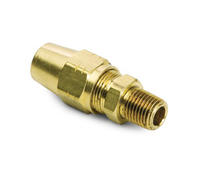
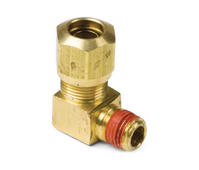
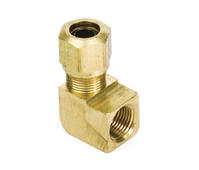
Compression fittings create a leak-tight seal by mechanically deforming a ferrule (or olive) against the pipe outer diameter. They are widely used for copper, plastic, and stainless steel tubing in water supply, gas, and instrumentation systems. Because they require no soldering, welding, or adhesives, compression fittings are the preferred choice for retrofits, tight spaces, and applications requiring future disassembly. This category is covered in depth in a dedicated section below.
Push-fit brass fittings accept tubing by simple insertion — an internal collet grips the tube and a rubber O-ring provides the seal. They are the fastest installation method available, typically requiring zero tools and under 5 seconds per connection. They are rated for cold and hot water supply, but should not be used in gas applications without explicit manufacturer approval. Maximum working pressure for most push-fit brass fittings is 10–16 bar (145–232 PSI).
Flare fittings are used extensively in refrigeration, air conditioning, and gas systems. The tube end is flared outward using a flaring tool to a standardized angle (45° SAE or 37° JIC), and the fitting body compresses against this flared surface when tightened. Flare connections are fully re-usable and rated for high-pressure gas service — characteristics that make them the preferred choice for refrigerant lines and natural gas supply connections where reliability is critical.
Brass barbed fittings grip flexible hoses through radial barbs that bite into the hose inner diameter when a hose clamp is applied. They are used in irrigation, fuel systems, pneumatics, and general fluid transfer. Barbed fittings are the lowest-cost brass fitting option and are widely available from general-line distributors.
Among all brass fitting types, compression fittings deserve particular attention because they are simultaneously the most widely misunderstood and the most frequently misspecified. When correctly selected and installed, they provide leak-free performance for 20–30 years or longer. When incorrectly specified or installed, they are a leading source of field failures.
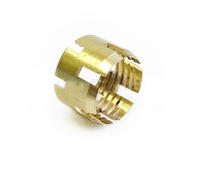
A standard compression fitting consists of three components: the fitting body, the compression nut, and the ferrule (also called the olive or ring). When the nut is tightened onto the body, the fitting body's angled seat forces the ferrule to compress radially inward against the outer diameter of the tube, simultaneously creating a mechanical grip and a metal-to-metal seal. The tube itself is not deformed — only the ferrule is.
The quality of the ferrule is the single most important variable in compression fitting performance. A well-formed brass ferrule — uniform wall thickness, correct hardness, proper geometry — will compress evenly and seal reliably across a wide range of installation torques. A poorly manufactured ferrule may split, gall, or seat asymmetrically, leading to leaks that are often not detectable until the system is pressurized.
Under the EN 1254-2 European standard and equivalent specifications, compression fittings are classified into two types:
| Tube Material | Compatible with Brass Compression? | Insert Required? | Notes |
|---|---|---|---|
| Copper (hard) | Yes | No | Ideal combination; most widely used |
| Copper (soft / annealed) | Yes | No | Avoid over-tightening |
| HDPE / PE-RT | Yes (with insert) | Yes | Insert prevents tube collapse under ferrule |
| PEX | Yes (with insert) | Yes | Verify fitting is rated for PEX |
| Stainless Steel (soft) | Yes | No | Use stainless ferrule for aggressive media |
| Steel (hard) | Not recommended | N/A | Ferrule cannot adequately grip hard steel OD |
The brass fittings market is populated by products of wildly varying quality, and price is an unreliable guide. A fitting that is 30% cheaper at purchase but fails prematurely can cost 10–100 times its purchase price in remediation — rework, water damage, warranty claims, or in critical applications, safety incidents. Certification to recognized standards is the most reliable indicator of consistent quality from brass fittings manufacturers.
The global brass fittings manufacturing industry is highly fragmented, with thousands of manufacturers ranging from large, vertically integrated operations to small workshops producing low-cost commodity items. For buyers sourcing at volume — distributors, OEM equipment manufacturers, commercial contractors — evaluating manufacturers rigorously is essential to supply chain reliability.
The first question to ask any brass fittings manufacturer is: what brass alloy do you use, and how do you verify it? The answer should specify the alloy designation (e.g., CW617N for standard European brass, C36000 for free-machining brass, CW602N for DZR brass) and describe the incoming material inspection process. Manufacturers who cannot answer this question with specificity are unlikely to have the quality systems necessary for consistent production.
Alloy substitution — using lower-grade or recycled brass without disclosure — is a documented problem in the commodity brass fittings market. X-ray fluorescence (XRF) testing of samples from new suppliers is a cost-effective screening method (typical cost: $15–30 per sample from an independent laboratory) that can identify alloy non-conformances before they cause field failures.
Brass fittings require tight dimensional tolerances to function correctly. Thread geometry (pitch, angle, diameter) must conform to the specified standard; ferrule dimensions must match the tube OD and fitting body seat geometry precisely; wall thicknesses must meet minimum pressure ratings. A manufacturer without calibrated measurement equipment — CMM (coordinate measuring machine), thread gauges, optical comparators — cannot consistently produce fittings to specification.
Request dimensional inspection reports (FAI — First Article Inspection) for new part numbers, and conduct periodic spot-checks on production lots. Leading brass fittings manufacturers will provide these reports proactively as part of their standard quality documentation package.
Many brass fittings are supplied with electroplated or other surface finishes — nickel plating for corrosion resistance and appearance, chrome plating for decorative applications, tin plating for specific fluid compatibility requirements. Plating quality varies enormously between manufacturers. Minimum nickel plating thickness for corrosion resistance should be 5–8 μm; decorative chrome systems typically require a nickel undercoat of 10–15 μm beneath a 0.2–0.5 μm chrome topcoat. Plating below these thresholds will fail prematurely in field conditions.
Correct specification requires matching the fitting type, material grade, pressure rating, and certifications to the demands of the specific application. The following guidance covers the most common application categories.
Brass fittings are one of those product categories where the difference between a good decision and a poor one is rarely visible at the point of purchase — it becomes visible months or years later, in the field, often in the worst possible circumstances. The combination of correct specification, certification verification, and supplier qualification is not bureaucratic overhead — it is the practical engineering foundation of systems that perform reliably over decades.
For buyers working with brass fittings manufacturers, the key principles are: know your alloy requirements and verify them; specify the right fitting type for the connection method and substrate material; require relevant certifications for the application and jurisdiction; and evaluate manufacturers on quality systems and documentation capability — not just unit price. Compression fittings, in particular, reward careful selection and correct installation: when both are right, they are among the most reliable, long-lived, and maintenance-free connections available in fluid and gas systems engineering.
Add:Xingzhong Road DianKou Town Zhuji City Zhejiang Province China
Mob: 0086-139 8951 3573
Tel: 0086-575-87560582
Fax: 0086-575-87560582
E-mail:[email protected]

 英语
英语 西班牙语
西班牙语